Coordination and Response
How the nervous and hormonal systems control the body
Control Systems
Nervous and hormonal coordination
| Feature | Nervous System | Hormonal System |
|---|---|---|
| Signal type | Electrical impulses | Chemical hormones |
| Transmission | Along neurons | In bloodstream |
| Speed | Very fast (milliseconds) | Slower (seconds to hours) |
| Duration | Short-lived | Long-lasting |
| Target | Specific muscle/gland | Multiple target organs |
| Example | Reflex to hot object | Growth, metabolism |
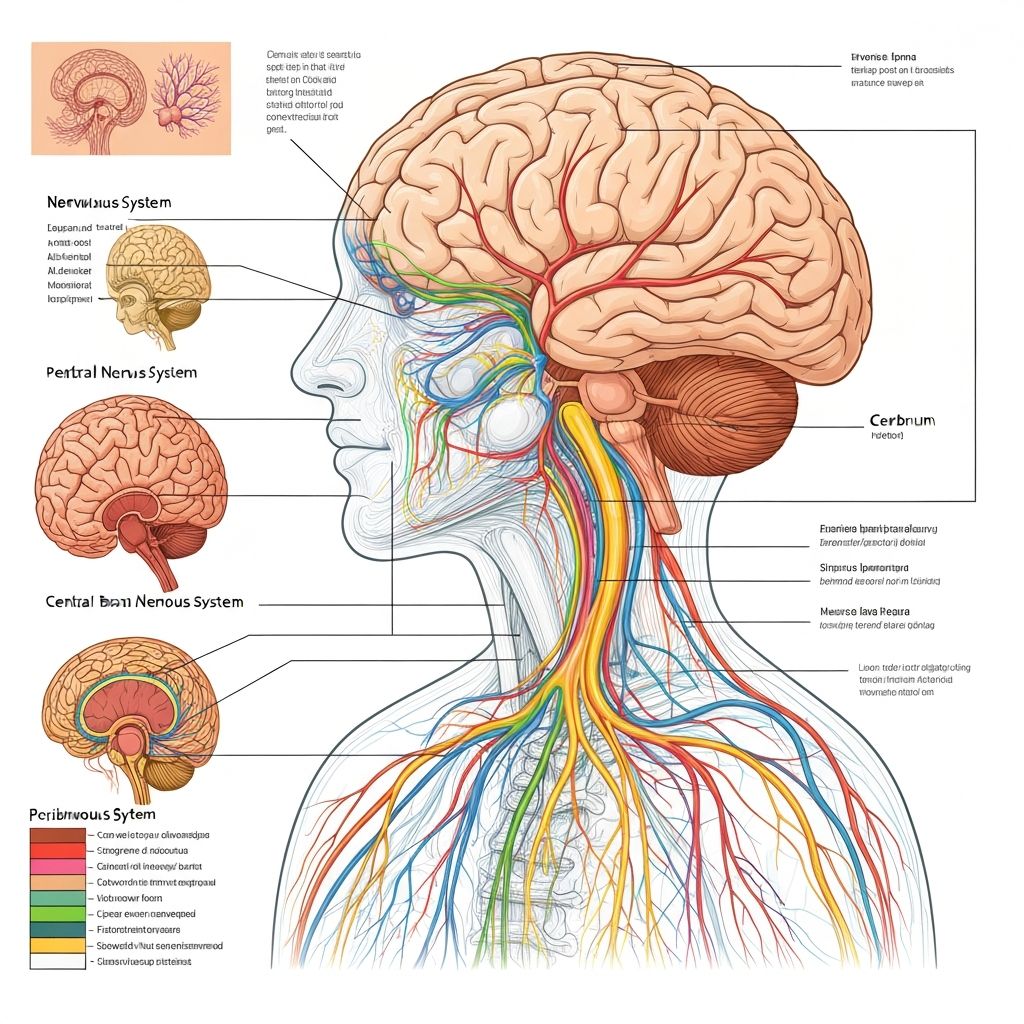
The nervous system allows rapid responses to stimuli. It consists of the Central Nervous System (CNS) - the brain and spinal cord - and the Peripheral Nervous System (PNS) - all the nerves connecting the CNS to the body.
Central Nervous System (CNS)
- Brain: processes information, makes decisions
- Spinal cord: connects brain to body, handles reflexes
- Protected by skull and vertebrae
Types of Neurons
- Sensory neurons: carry impulses from receptors to CNS
- Motor neurons: carry impulses from CNS to effectors
- Relay neurons: connect neurons within CNS
Synapses
A synapse is the junction between two neurons. When an impulse arrives, it triggers the release of neurotransmitters (chemical messengers) that diffuse across the tiny gap and trigger an impulse in the next neuron.
A reflex is an automatic response that doesn't involve conscious thought. Reflexes protect us from danger by reacting faster than we can think.
Reflex Arc Pathway
Example: Touching a Hot Object
- Stimulus: heat from hot pan
- Receptor: temperature receptors in skin detect heat
- Sensory neuron: carries impulse to spinal cord
- Relay neuron: passes signal in spinal cord (not brain)
- Motor neuron: carries impulse to arm muscles
- Effector: arm muscles contract
- Response: hand pulls away from heat
Neuron
Neuron
Neuron
Click 'Start Reflex' to simulate touching a hot object
Click the button below to start
What's happening?
When you see green, light receptors in your eyes send impulses along sensory neurons to your brain. Your brain processes this and sends impulses along motor neurons to your finger muscles. Average human reaction time is 200-300ms. Unlike reflexes, this involves conscious thought, so it's slower than a reflex arc.
Hormones are chemical messengers produced by endocrine glands and carried in the blood to target organs. They control slower, longer-lasting processes like growth, metabolism, and reproduction.
Pituitary Gland
The "master gland" in the brain. Produces hormones that control other glands, including FSH and LH (reproductive hormones) and growth hormone.
Thyroid Gland
In the neck. Produces thyroxine which controls metabolic rate - how fast chemical reactions happen in cells.
Pancreas
Produces insulin (lowers blood glucose) and glucagon (raises blood glucose) to maintain blood sugar levels.
Adrenal Glands
Above the kidneys. Produce adrenaline for fight-or-flight response: increases heart rate, breathing, and releases glucose for energy.
The menstrual cycle is controlled by four hormones working together in a feedback loop. The cycle lasts about 28 days and prepares the uterus for pregnancy each month.
FSH (Follicle Stimulating Hormone)
From pituitary gland. Stimulates egg development in ovaries and triggers estrogen production.
Estrogen
From ovaries. Repairs and thickens uterus lining. High levels trigger LH release and inhibit FSH.
LH (Luteinizing Hormone)
From pituitary gland. A surge around day 14 triggers ovulation (egg release).
Progesterone
From empty follicle (corpus luteum). Maintains thick uterus lining. If no pregnancy, levels drop and menstruation begins.
What's happening?
Ovulation! LH surge causes mature egg to be released from ovary.
Plants respond to stimuli using growth responses called tropisms, controlled by plant hormones like auxins.
Phototropism
Growth response to light. Shoots grow towards light (positive phototropism). Auxin moves to the shaded side, causing more growth there, bending the shoot toward light.
Geotropism (Gravitropism)
Growth response to gravity. Roots grow downward (positive geotropism). Shoots grow upward (negative geotropism).
Plant Hormones:
- Auxins: control cell elongation, tropisms
- Gibberellins: promote stem growth, seed germination
Central Nervous System (CNS)
Question:
Explain why your pupil dilates in the dark (nervous response) and why blood glucose rises when you're scared (hormonal response).
Answer:
Pupil dilation (Nervous Response):
- Stimulus: low light levels detected by photoreceptors in the eye
- Sensory neurons carry impulses to the brain
- Brain processes the information and sends motor impulses to the eye
- Effector: radial muscles in the iris contract
- Response: pupil dilates (gets bigger) to let in more light
- This happens in milliseconds - very fast and automatic
Blood glucose rise (Hormonal Response):
- Stimulus: fear or stress (perceived danger)
- Brain signals the adrenal glands to release adrenaline
- Adrenaline travels in the bloodstream to target organs
- At the liver, adrenaline triggers conversion of glycogen to glucose
- Blood glucose rises, providing extra energy for muscles
- This takes seconds to minutes but lasts longer
Key Difference:
The nervous response (pupil) is fast and short-lived - electrical signals along neurons to a specific effector. The hormonal response (glucose) is slower but longer-lasting - chemical hormones in the blood affecting multiple organs to prepare the body for action.
What is the correct order of a reflex arc?