Photosynthesis
How plants convert light energy into chemical energy to produce glucose
Capturing Sunlight
The process that powers nearly all life on Earth
(light energy) C₆H₁₂O₆ + 6O₂
Reactants:
Carbon dioxide + Water
Products:
Glucose + Oxygen
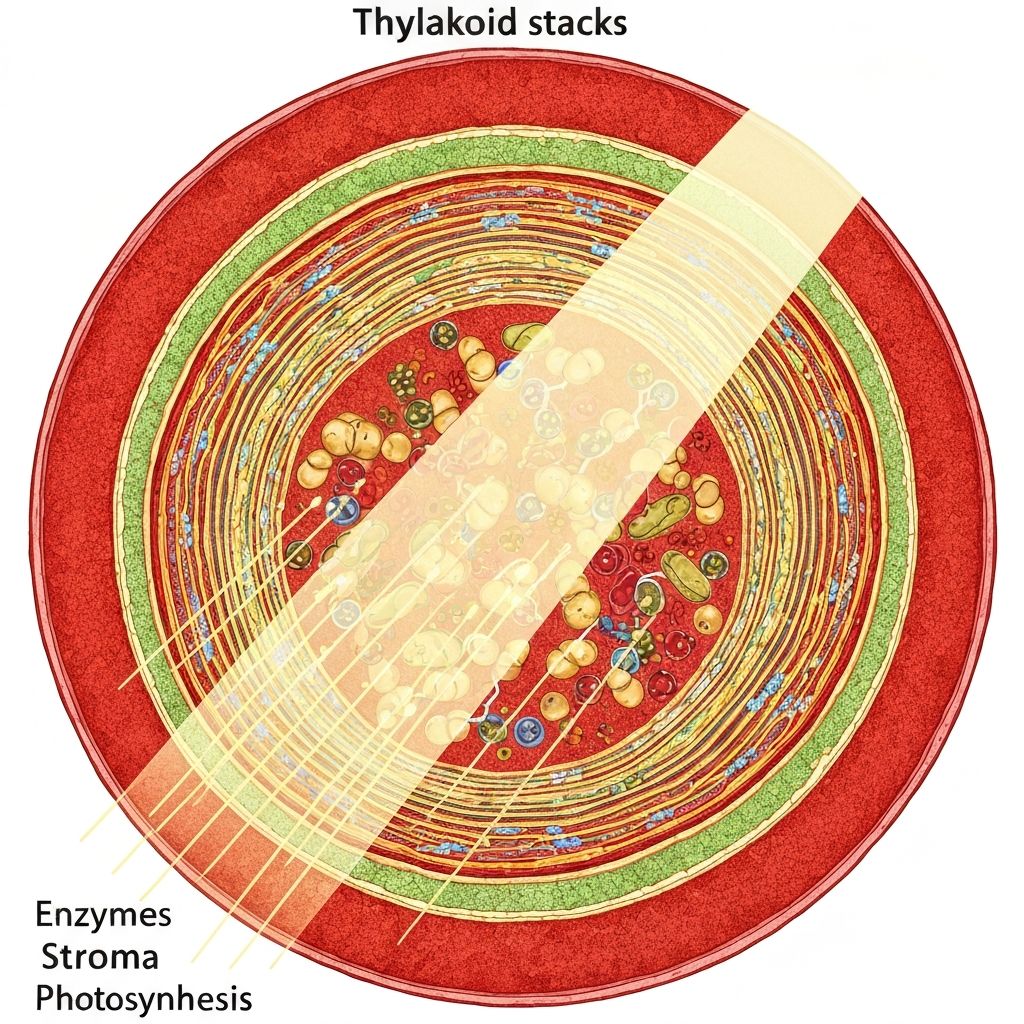
Photosynthesis occurs in chloroplasts, specialized organelles found in plant cells. Chloroplasts contain the green pigment chlorophyll, which absorbs light energy.
Thylakoids
Stack of membrane discs containing chlorophyll. This is where the light-dependent reactions occur.
Stroma
Fluid-filled space surrounding the thylakoids. This is where the light-independent reactions (Calvin cycle) occur.
Key Steps:
- Light absorption: Chlorophyll absorbs light energy
- Photolysis of water: Light energy splits water molecules into H⁺, e⁻, and O₂
- Energy transfer: Excited electrons move through the electron transport chain, making ATP
- NADPH production: Hydrogen ions combine with electrons to form NADPH
Products:
- ATP: Energy currency used in the next stage
- NADPH: Hydrogen carrier used in the next stage
- Oxygen (O₂): Released into the atmosphere as a by-product
Key Steps:
- Carbon fixation: CO₂ combines with a 5-carbon compound (RuBP)
- Reduction: ATP and NADPH convert the carbon compound into a 3-carbon sugar (G3P)
- Regeneration: Some G3P regenerates RuBP, other G3P makes glucose
Light Intensity
As light intensity increases, the rate of photosynthesis increases (up to a point).
CO₂ Concentration
As CO₂ concentration increases, the rate of photosynthesis increases (up to a point).
Temperature
Photosynthesis is controlled by enzymes. Optimal temperature is usually around 25-35°C.
Thylakoid Membrane
Light Energy
Absorbed by chlorophyll
Water Split
H₂O → H⁺ + e⁻ + O₂
ATP Made
Energy currency
NADPH Made
Hydrogen carrier
Products: ATP + NADPH + O₂ (released as waste)
These products are used in the Calvin cycle to make glucose
Glucose Production Rate
Moderate photosynthesis rate - some factors could be improved
Tip: The factor with the lowest value limits the overall rate. Try increasing each factor one at a time to see which one is currently limiting photosynthesis.
Photosynthesis
Question:
A plant is growing in a greenhouse. Explain how the rate of photosynthesis would change if:
- Light intensity is increased from low to medium
- Temperature is increased from 35°C to 50°C
Answer:
1. Increased light intensity:
Rate increases because more light energy is available for the light-dependent reactions.
2. Temperature 35°C → 50°C:
Rate decreases because enzymes start to denature above 40°C. The Calvin cycle slows down significantly.
Where do the light-dependent reactions of photosynthesis occur?