Cell Structure and Function
Understanding the building blocks of life and their specialised parts
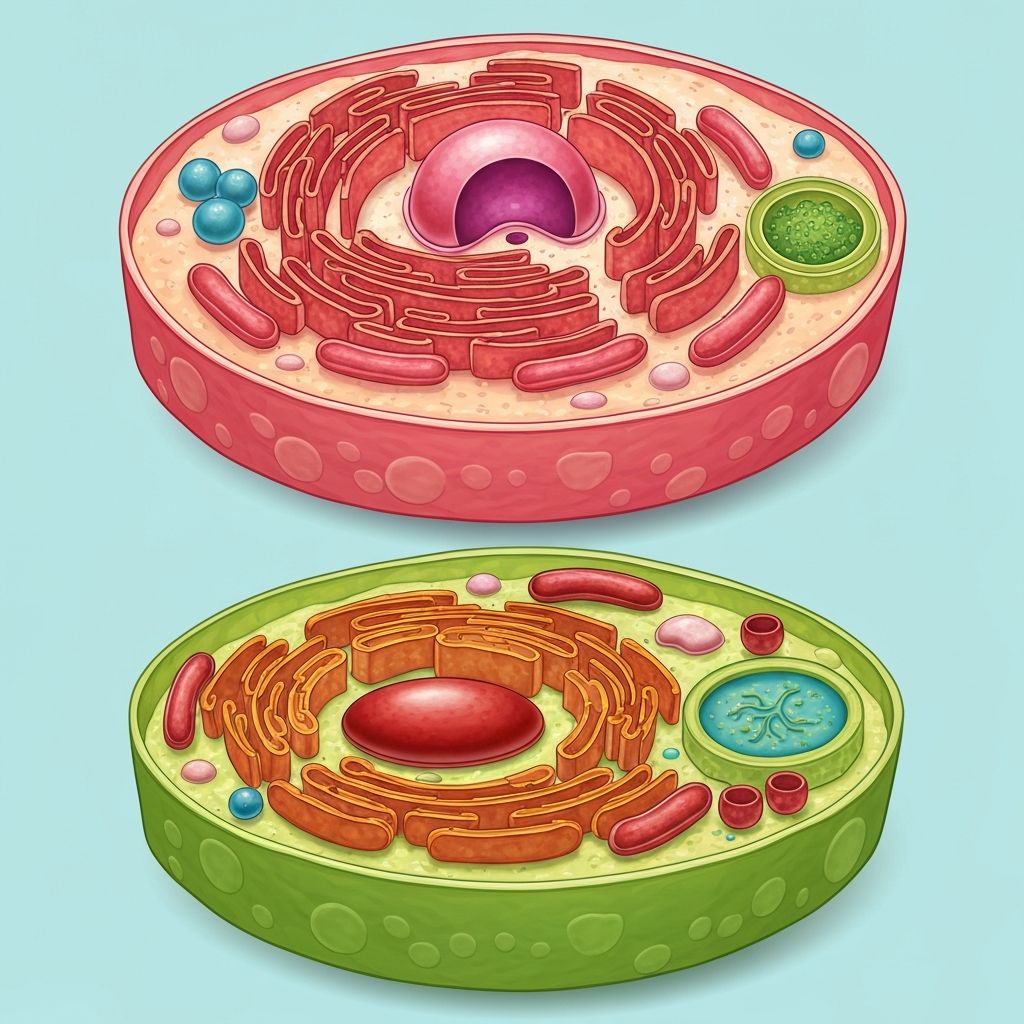
The Building Blocks of Life
Every living thing is made of cells
Every living thing, from bacteria to blue whales, is made of cells. Cells are the smallest unit of life that can carry out all life processes. Some organisms (like bacteria) are made of just one cell (unicellular), while others (like humans) are made of trillions of cells (multicellular).
Two Types of Cells
Eukaryotic Cells
- Have a nucleus containing DNA
- Have membrane-bound organelles
- Found in animals, plants, fungi
- Usually larger (10-100 μm)
Prokaryotic Cells
- No nucleus - DNA floats freely
- No membrane-bound organelles
- Found in bacteria only
- Much smaller (1-5 μm)
Animal Cell Organelles
Animal cells contain several key organelles, each with a specific function:
Plant Cells Have Extra Parts
Plant cells have everything animal cells have, PLUS three extra structures:
Fungal Cells
Fungal cells are similar to plant cells but with key differences: they have a cell wall made of chitin (not cellulose), they don't have chloroplasts (fungi can't photosynthesise), and they get nutrients by absorbing them from their surroundings.
Practical Note: Observing Cells
You can observe cells using a light microscope. Plant cells are easier to see because of their rigid cell wall. Use iodine stain to see animal cells more clearly, and methylene blue for cheek cells. Always start with the lowest magnification and focus carefully!
Toggle Organelles
Click an organelle to see its function
| Structure | Animal Cell | Plant Cell | Prokaryote |
|---|---|---|---|
| Cell Membrane | |||
| Cytoplasm | |||
| Ribosomes | |||
| DNA | |||
| Nucleus | |||
| Mitochondria | |||
| Cell Wall | |||
| Chloroplasts | |||
| Large Vacuole | |||
| Plasmid DNA | |||
| Flagellum |
Animal Cell
No cell wall, no chloroplasts. Flexible shape. Gets energy by eating food.
Plant Cell
Has cell wall, chloroplasts, and large vacuole. Fixed shape. Makes own food.
Prokaryote
No nucleus or membrane-bound organelles. Much smaller. Includes bacteria.
Question:
Explain why plant cells have chloroplasts but animal cells do not.
Answer:
Key Point: Chloroplasts are only found in cells that photosynthesise. Even in plants, root cells (underground, no light) have very few or no chloroplasts!
Which organelle is called the 'powerhouse' of the cell?