Movement Across Membranes
Understanding diffusion, osmosis, and active transport in living cells
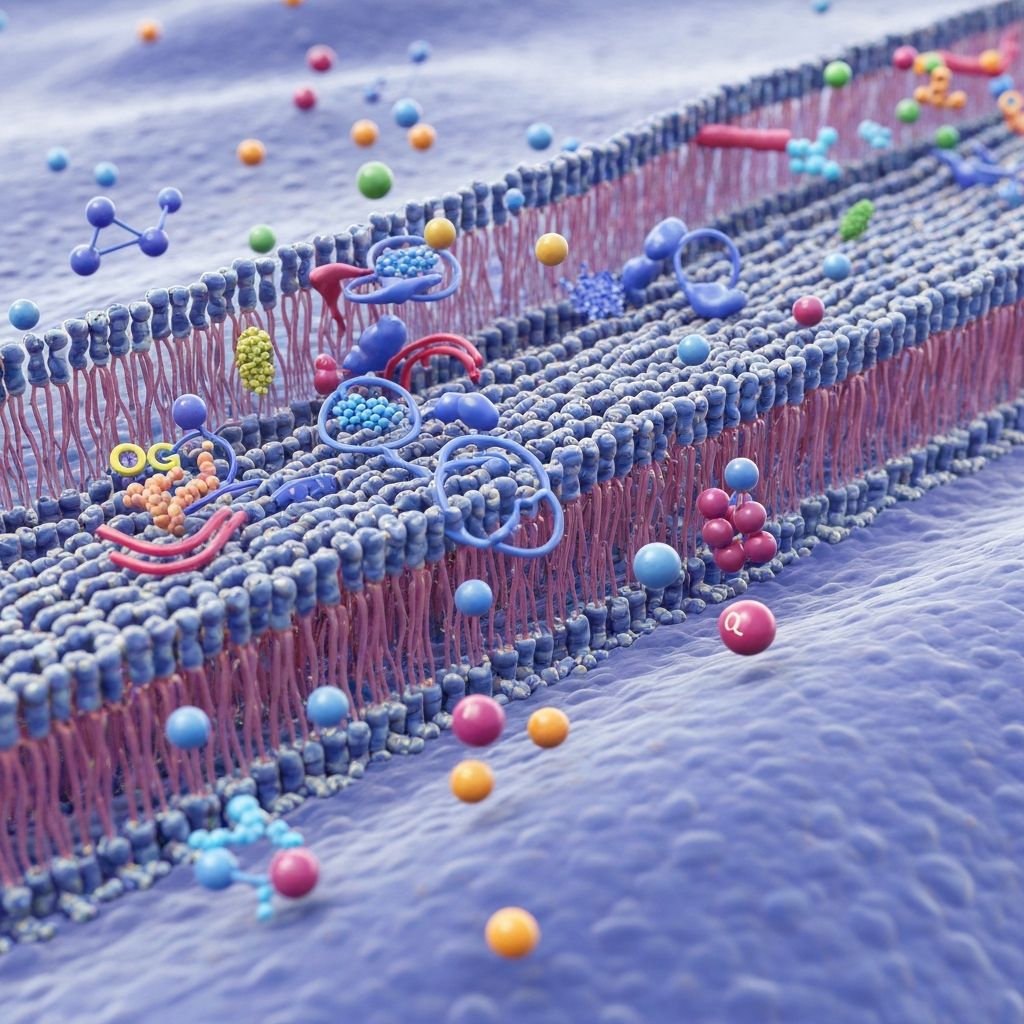
Cellular Traffic Control
How substances move in and out of cells
| Process | Direction | Energy Required? | Examples |
|---|---|---|---|
| Diffusion | High → Low concentration | No (passive) | Oxygen into cells, CO₂ out of cells |
| Osmosis | High → Low water potential | No (passive) | Water into roots, water into/out of cells |
| Active Transport | Low → High concentration | Yes (requires ATP) | Glucose uptake in gut, mineral ions in roots |
Diffusion is the movement of particles from an area of high concentration to an area of low concentration.
Simple Diffusion:
Small molecules like oxygen (O₂), carbon dioxide (CO₂), and water can pass directly through the cell membrane.
Facilitated Diffusion:
Larger molecules like glucose need help from special protein channels or carrier proteins in the membrane.
Osmosis is the movement of water molecules from an area of high water potential (dilute solution) to an area of low water potential (concentrated solution) across a partially permeable membrane.
Osmosis in Plant Cells:
Turgor: When a plant cell is placed in pure water, water moves into the cell by osmosis. The cell swells, pushing against the cell wall. The cell becomes turgid (firm).
Plasmolysis: When a plant cell is placed in a concentrated salt or sugar solution, water moves out of the cell by osmosis. The cell becomes plasmolysed (floppy).
Active transport moves substances from an area of low concentration to an area of high concentration - the opposite direction to diffusion. This requires energy in the form of ATP.
Why Is Active Transport Needed?
Glucose absorption in the small intestine: Even when glucose concentration is higher inside the cells than in the gut, active transport continues to absorb glucose.
Mineral ion uptake in root hair cells: Plants need to absorb minerals like nitrate and magnesium from soil even when concentration is higher in root cells.
Diffusion of Oxygen
High Concentration
Low Concentration
Click 'Start' to see oxygen diffuse from high to low concentration.
Diffusion
Question:
An onion cell is placed in distilled water. A second onion cell is placed in a concentrated salt solution. Explain what happens to each cell and why.
Answer:
Cell 1: Onion cell in distilled water
The cell becomes turgid. Water moves into the cell by osmosis (from high water potential outside to low water potential inside). The cell wall prevents bursting.
Cell 2: Onion cell in salt solution
The cell becomes plasmolysed. Water moves out of the cell by osmosis. The cell membrane pulls away from the cell wall.
Oxygen moving from the lungs into the blood