Excretion and Osmoregulation
How kidneys remove waste and control water balance
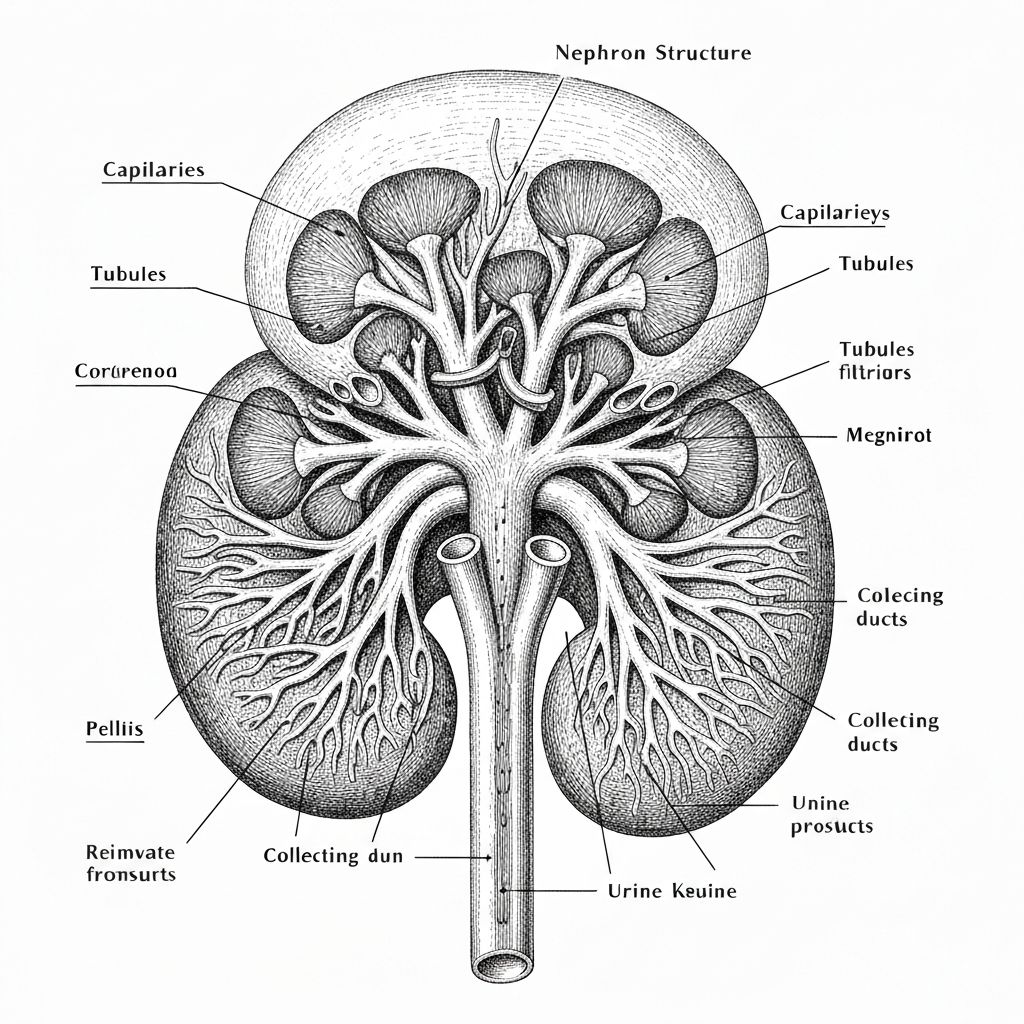
Waste Removal
Filtering blood and maintaining water balance
Excretion is the removal of toxic waste products made by metabolism. It's essential because waste products like urea and carbon dioxide are harmful if they build up.
Urea
Made in the liver from breakdown of excess amino acids (from proteins). Removed by kidneys in urine.
Carbon Dioxide
Made by respiration in all cells. Removed by lungs when we breathe out.
Water & Ions
Excess water and mineral ions removed by kidneys (urine) and skin (sweat).
Each kidney contains about one million tiny filtering units called nephrons. Blood enters through the renal artery, waste is filtered out, and clean blood leaves through the renal vein.
Kidney Parts
- Cortex: outer layer, contains nephrons
- Medulla: inner layer, collecting ducts
- Pelvis: central cavity, urine collects
- Ureter: tube carrying urine to bladder
Nephron Parts
- Glomerulus: ball of capillaries
- Bowman's capsule: cup around glomerulus
- Tubule: long coiled tube
- Collecting duct: final urine concentration
1. Ultrafiltration
High blood pressure forces small molecules through tiny pores in glomerulus into Bowman's capsule.
2. Selective Reabsorption
Useful substances are reabsorbed from the tubule back into the blood. This happens by active transport and diffusion.
3. Osmoregulation
ADH (Anti-Diuretic Hormone) from the pituitary gland controls how much water is reabsorbed in the collecting duct. This maintains water balance.
Filtered Into Capsule:
Remain In Blood:
If kidneys fail, toxic waste (especially urea) builds up in blood. Without treatment, this is fatal.
Dialysis
Machine filters blood artificially. Patient connected to machine 3-4 times per week for several hours.
Advantages: keeps patient alive, no surgery needed
Disadvantages: time-consuming, dietary restrictions, not a cure
Kidney Transplant
Healthy kidney from donor transplanted into patient. Works like natural kidney.
Advantages: better quality of life, no regular dialysis
Disadvantages: donor needed, risk of rejection, immunosuppressant drugs
Scenario 1: After Drinking Lots of Water
- Blood becomes diluted (low concentration)
- Brain detects this and pituitary releases LESS ADH
- Collecting duct walls become less permeable to water
- LESS water reabsorbed back into blood
- MORE water stays in tubule
- Result: Large volume of dilute (pale) urine
Scenario 2: After Sweating (Exercise/Hot Day)
- Lost water through sweat, blood becomes concentrated
- Brain detects this and pituitary releases MORE ADH
- Collecting duct walls become more permeable to water
- MORE water reabsorbed back into blood
- LESS water stays in tubule
- Result: Small volume of concentrated (dark) urine
Key Concept: ADH maintains water balance through negative feedback. The body constantly adjusts ADH levels to keep blood concentration stable.