Chemical Calculations – The Mole
Master quantitative chemistry with mole calculations, reacting masses, and empirical formulae
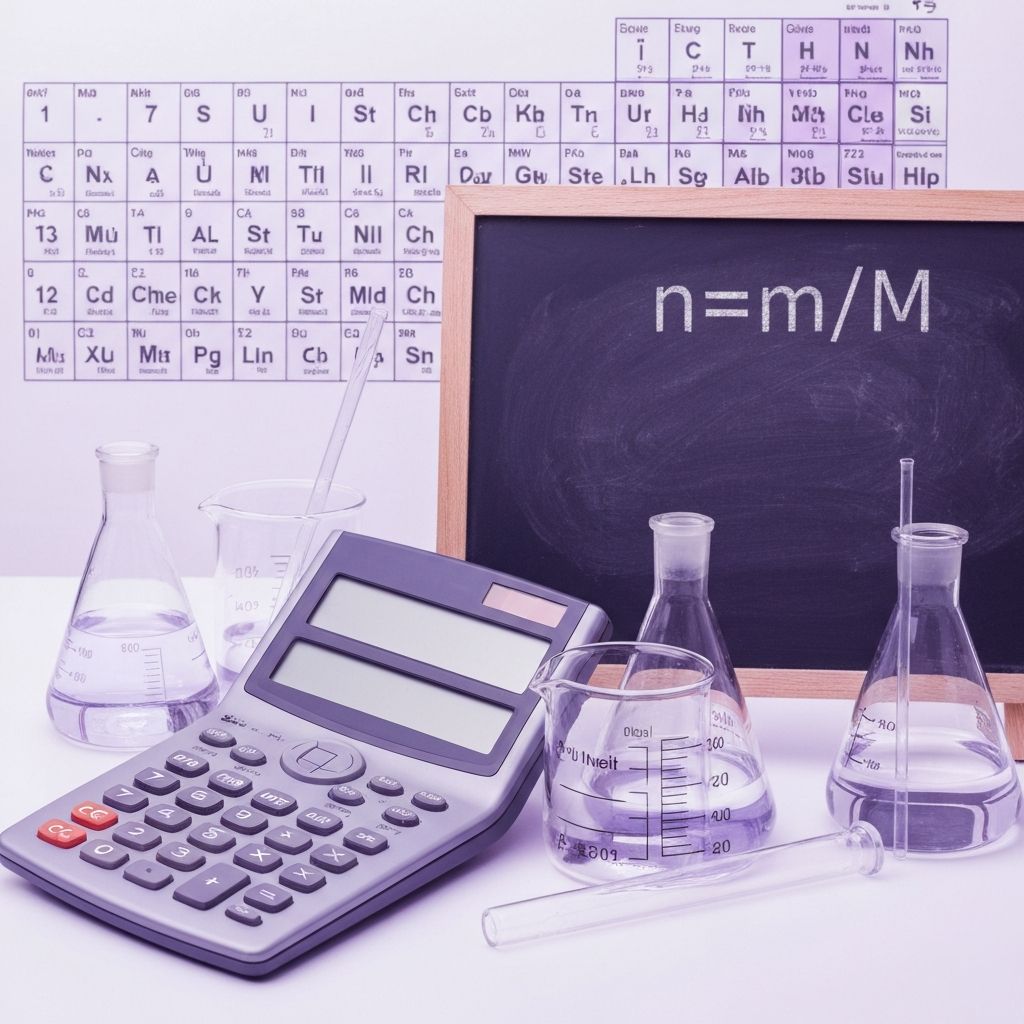
n = m / M
The mole triangle - your key to all calculations
Moles
n = m ÷ M
Concentration
c = m ÷ V
% Yield
(actual ÷ theoretical) × 100%
% by Mass
(element mass ÷ Mr) × 100%
Avogadro
6.02 × 10²³ per mol
Volume
1 dm³ = 1000 cm³
Understanding Chemical Calculations
Chemical calculations allow chemists to predict quantities in reactions. The mole is the central unit connecting mass, particles, and chemical equations. One mole of any substance contains exactly 6.02 × 10²³ particles (Avogadro's constant).
Relative Formula Mass (Mr)
The relative formula mass is calculated by adding the relative atomic masses (Ar) of all atoms in a formula. For example, water (H₂O) has Mr = (2 × 1) + 16 = 18, and calcium carbonate (CaCO₃) has Mr = 40 + 12 + (3 × 16) = 100.
The Mole Triangle
The relationship between mass (m), moles (n), and molar mass (M) can be remembered using the triangle: n = m/M. This allows conversion between any two quantities when you know the third.
Reacting Mass Calculations
To calculate reacting masses: (1) write the balanced equation, (2) find moles of the known substance, (3) use the mole ratio from coefficients, (4) calculate mass of the unknown. This method works for any stoichiometric calculation.
Percentage Yield and Concentration
Percentage yield compares actual product obtained to theoretical maximum. Yields below 100% result from incomplete reactions, side reactions, or transfer losses. Concentration in g/dm³ measures how much solute is dissolved per unit volume.
Empirical Formula
The empirical formula shows the simplest whole number ratio of atoms. To find it: convert masses to moles by dividing by Ar, divide all values by the smallest, and round to whole numbers.
Common Ar Values
Example 1: Calculate moles in 54g of water
Mr of H₂O = (2×1) + 16 = 18
n = m ÷ M = 54 ÷ 18 = 3 mol
Example 2: Mass of CO₂ from 10g CaCO₃ decomposing
CaCO₃ → CaO + CO₂
Moles CaCO₃ = 10 ÷ 100 = 0.1 mol
Ratio 1:1, so moles CO₂ = 0.1 mol
Mass CO₂ = 0.1 × 44 = 4.4 g
Example 3: Empirical formula from 40% C, 6.7% H, 53.3% O
C: 40/12 = 3.33 mol
H: 6.7/1 = 6.7 mol
O: 53.3/16 = 3.33 mol
Divide by smallest (3.33): C=1, H=2, O=1
Empirical formula: CH₂O
Relative atomic mass (Ar)
What is the relative formula mass (Mr) of H₂O?