Chemical Tests for Ions and Gases
Identifying unknown substances through chemical analysis
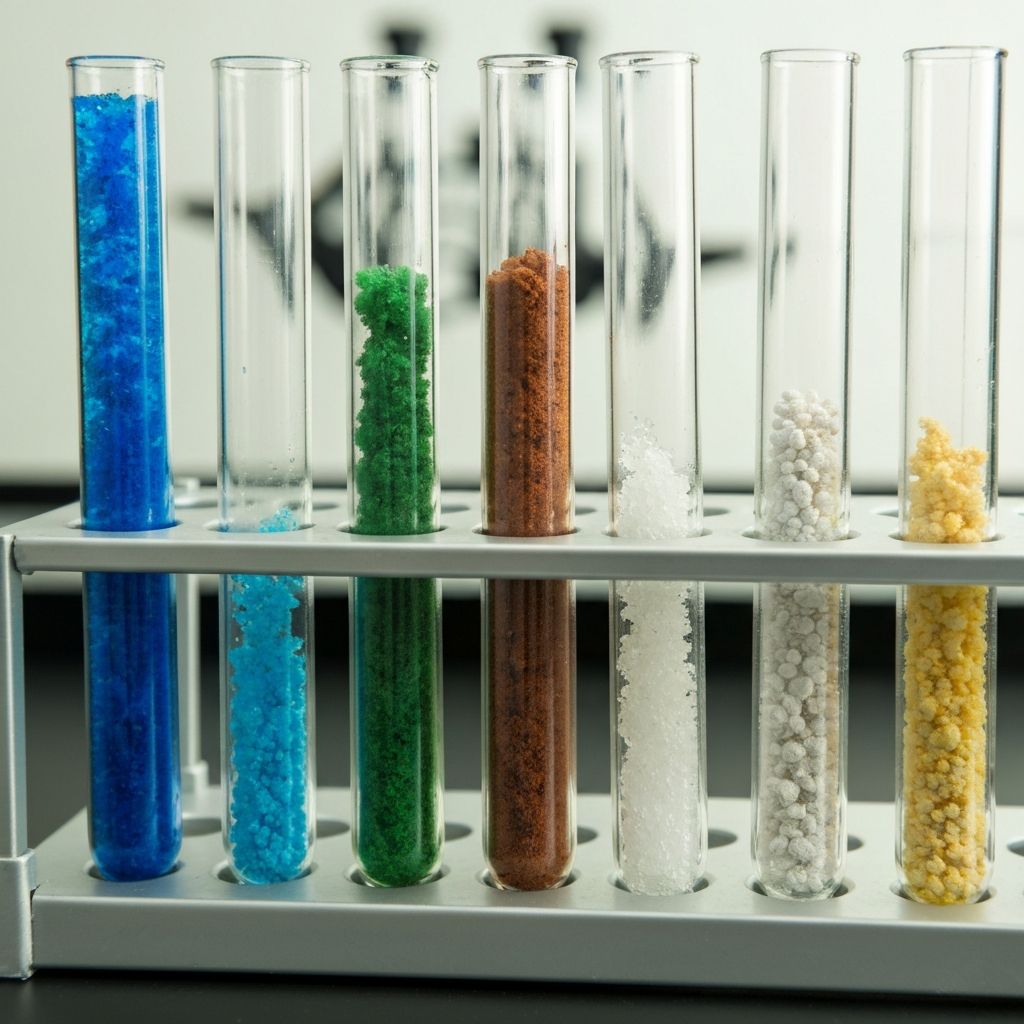
Chemical tests help identify unknown ions and gases through characteristic reactions and color changes
Chemical tests are essential techniques for identifying unknown substances. Different ions and gases produce characteristic results when tested with specific reagents, allowing us to determine what compounds are present in a sample.
Testing for Cations (Positive Ions)
Most cation tests use sodium hydroxide solution (NaOH) as the reagent. When added to solutions containing metal ions, NaOH produces colored precipitates. Copper(II) ions give a blue precipitate, iron(II) ions give a green precipitate, and iron(III) ions give a brown/orange precipitate. Ammonium ions are special - warming with NaOH releases ammonia gas, which has a pungent smell and turns damp red litmus paper blue.
Testing for Anions (Negative Ions)
Different anions require different reagents. Halide ions (chloride, bromide, iodide) are tested using acidified silver nitrate, producing white, cream, or yellow precipitates respectively. Carbonate ions fizz with dilute acid, releasing carbon dioxide that turns limewater milky. Sulfate ions produce a white precipitate with acidified barium chloride.
Testing for Gases
Each gas has a unique test: hydrogen gives a squeaky pop with a burning splint, oxygen relights a glowing splint, carbon dioxide turns limewater milky, ammonia turns damp red litmus blue, and chlorine bleaches damp blue litmus white.
Flame Tests for Metal Ions
Metal ions produce characteristic flame colors when heated. Lithium gives a crimson red flame, sodium gives yellow/orange, potassium gives lilac/purple, and copper gives blue-green. These distinctive colors help identify which metal is present.
| Ion | Reagent | Result | Color |
|---|---|---|---|
| NH₄⁺ | NaOH (warm) | Ammonia gas released | |
| Cu²⁺ | NaOH | Blue precipitate | |
| Fe²⁺ | NaOH | Green precipitate | |
| Fe³⁺ | NaOH | Brown precipitate |
Example 1: Identifying an Unknown Anion
Question: An unknown solution produces a white precipitate when acidified silver nitrate is added. What anion is present?
Solution: The acidified silver nitrate test is used for halide ions:
- Chloride (Cl⁻) → white precipitate (AgCl)
- Bromide (Br⁻) → cream precipitate (AgBr)
- Iodide (I⁻) → yellow precipitate (AgI)
Answer: Since a white precipitate formed, the anion present is chloride (Cl⁻).
Example 2: Flame Test Identification
Question: A compound is tested using a flame test and produces a yellow/orange flame. Which metal ion is present?
Solution: Compare with known flame colors:
- Lithium → crimson/red
- Sodium → yellow/orange
- Potassium → lilac/purple
- Copper → blue-green
Answer: The yellow/orange flame indicates sodium (Na⁺) ions are present.
Test for Cu²⁺ ions
Which reagent is used to test for halide ions?