Acids, Bases, and Salts
Understand the pH scale, neutralization reactions, and salt formation
Acids and Bases
The chemistry of pH and neutralization
Acids are substances that produce hydrogen ions (H⁺) when dissolved in water. They taste sour, can corrode metals, and have a pH less than 7. Common acids include hydrochloric acid (HCl), sulfuric acid (H₂SO₄), nitric acid (HNO₃), and ethanoic acid (CH₃COOH).
Bases are substances that neutralize acids. They produce hydroxide ions (OH⁻) and have a bitter taste. Alkalis are bases that dissolve in water, such as sodium hydroxide (NaOH), potassium hydroxide (KOH), and ammonia solution (NH₃).
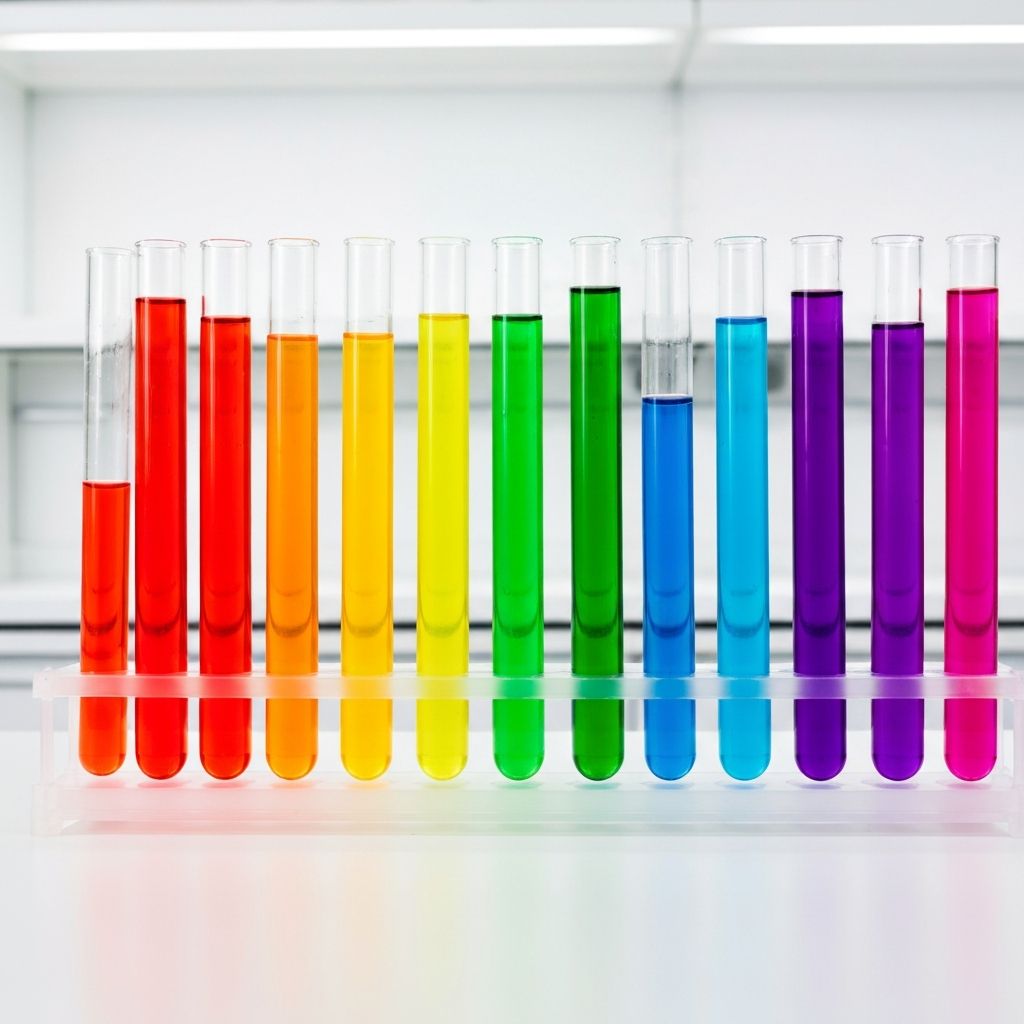
The pH scale measures how acidic or alkaline a solution is, ranging from 0 to 14. A pH of 7 is neutral (pure water). Values below 7 are acidic (more H⁺ ions), and values above 7 are alkaline (more OH⁻ ions). Universal indicator shows different colors at different pH values.
Key Exam Point
Strong acids (HCl, H₂SO₄, HNO₃) fully dissociate in water – all molecules split into ions. Weak acids (like ethanoic acid) only partially dissociate. This affects their pH and reactivity.
Neutralization occurs when an acid reacts with a base to form a salt and water: Acid + Base → Salt + Water. At the ionic level: H⁺ + OH⁻ → H₂O.
Salts are ionic compounds formed from the positive ion of a base and the negative ion of an acid. The name tells you the acid used: chloride (from HCl), sulfate (from H₂SO₄), nitrate (from HNO₃).
Metals react with acids to produce a salt and hydrogen gas: Zn + 2HCl → ZnCl₂ + H₂↑. Only metals above hydrogen in the reactivity series will react.
Carbonates react with acids to produce a salt, water, and carbon dioxide: CaCO₃ + 2HCl → CaCl₂ + H₂O + CO₂↑. The CO₂ causes fizzing/effervescence.
pH 7
Neutral
Similar to: Pure water
Common Acids
Common Bases/Alkalis
Question:
Write a balanced equation for the reaction between sulfuric acid and potassium hydroxide. Name the salt formed.
Answer:
Step 1: Identify the reactants.
Acid: H₂SO₄ (sulfuric acid) | Base: KOH (potassium hydroxide)
Step 2: Work out the salt. The metal (K) from the base combines with the sulfate (SO₄) from the acid = potassium sulfate.
Step 3: Write and balance the equation. Sulfuric acid has 2 H⁺ ions, so needs 2 KOH molecules:
H₂SO₄ + 2KOH → K₂SO₄ + 2H₂O
Salt formed: Potassium sulfate (K₂SO₄)
What ions do acids produce when dissolved in water?