Group 7 Elements – Halogens
Discover the properties and reactions of fluorine, chlorine, bromine, and iodine
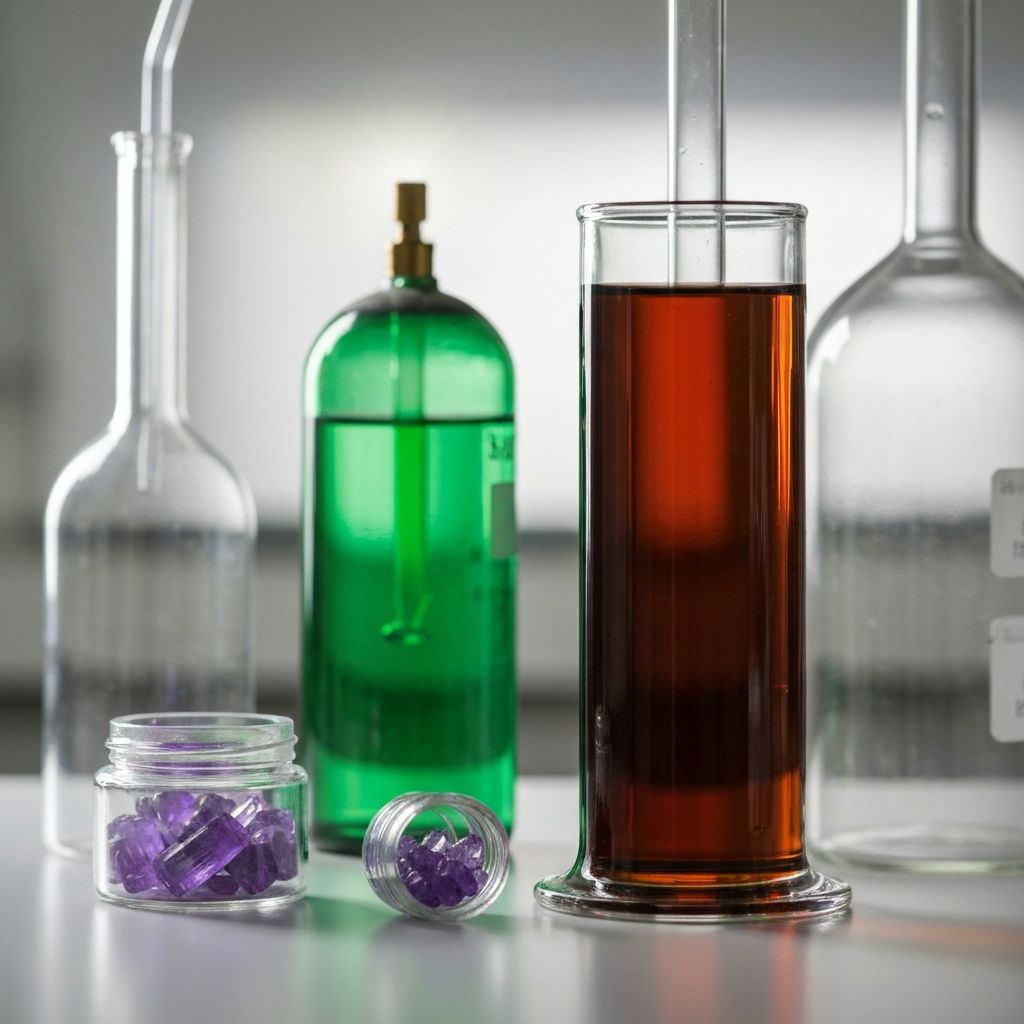
The Halogens
Reactive non-metals in Group 7
The Group 7 elements are called halogens: fluorine (F), chlorine (Cl), bromine (Br), iodine (I), and astatine (At). They all have seven electrons in their outer shell and need to gain one electron to achieve a stable octet. They exist as diatomic molecules (F₂, Cl₂, Br₂, I₂).
Physical states vary at room temperature: fluorine and chlorine are gases, bromine is a liquid, and iodine is a solid. Colors intensify down the group from pale yellow (F₂) to yellow-green (Cl₂) to brown (Br₂) to dark gray with purple vapor (I₂).
Reactivity decreases down the group because the outer shell is further from the nucleus, making it harder to attract and gain an extra electron. This is the opposite trend to Group 1. Boiling points increase down the group due to stronger van der Waals forces between larger molecules.
Key Exam Point
In displacement reactions, a more reactive halogen will displace a less reactive halide ion from solution. Chlorine can displace bromide and iodide. Bromine can only displace iodide. Iodine cannot displace any halide.
With metals: Halogens react vigorously with metals to form ionic salts called metal halides. For example: 2Fe + 3Cl₂ → 2FeCl₃ (iron(III) chloride).
With hydrogen: Halogens react with hydrogen to form hydrogen halides, which dissolve in water to form acids: H₂ + Cl₂ → 2HCl. HCl dissolves to form hydrochloric acid.
Displacement reactions: A more reactive halogen can displace a less reactive halide from its compound: Cl₂ + 2NaBr → 2NaCl + Br₂. The solution turns brown as bromine is released. This occurs because chlorine is more reactive and preferentially takes the electrons.
Uses: Chlorine is used to sterilize drinking water and swimming pools. Fluorine compounds are added to toothpaste and water supplies to prevent tooth decay. Iodine is used as a disinfectant and is essential for thyroid function.
Chlorine
Atomic number: 17
State at room temp
Gas
Color
Yellow-green
Boiling point
-35°C
Reactivity
Very High
Electron configuration
2,8,7
Common uses
Water purification, bleach
Displacement Reactions
Select a reaction to see if it occurs:
Question:
Predict what happens when bromine solution is added to potassium iodide solution. Write a balanced equation and explain your answer using reactivity.
Answer:
A displacement reaction occurs. The solution will turn from orange-brown to a darker brown color.
Balanced equation:
Br₂ + 2KI → 2KBr + I₂
Explanation: Bromine is more reactive than iodine (higher in Group 7). Bromine atoms have their outer shell closer to the nucleus than iodine, so bromine can more easily attract and gain electrons. Bromine therefore displaces iodide ions from the solution, taking their electrons to form bromide ions, while iodine is released.
Why does reactivity decrease down Group 7?