Gases in the Atmosphere and Fractional Distillation
Understanding air composition, separation of gases, and combustion reactions
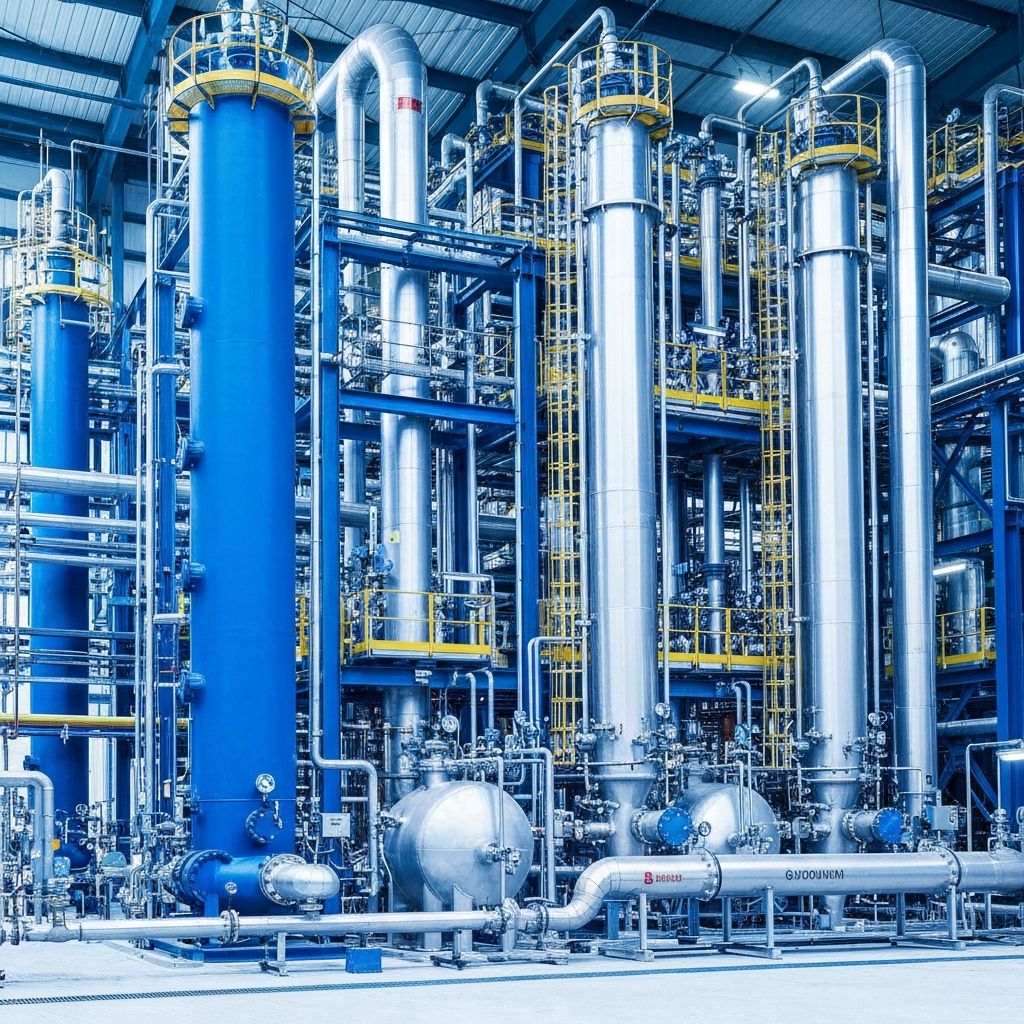
Air is a mixture of gases that can be separated by cooling to -200°C and using fractional distillation
The atmosphere is the layer of gases surrounding Earth. Clean, dry air contains approximately 78% nitrogen, 21% oxygen, about 1% noble gases(mainly argon), and roughly 0.04% carbon dioxide. These gases can be separated through fractional distillation of liquid air.
Fractional Distillation of Air
This industrial process separates air into its component gases. First, air is filtered to remove dust particles, then cooled to approximately -200°C to liquefy all the gases. The liquid air enters a fractionating column where gases separate based on their different boiling points. Nitrogen (bp -196°C) boils first and is collected at the top, argon (bp -186°C) is collected in the middle, and oxygen (bp -183°C) remains liquid longest and is collected at the bottom.
Processes Affecting Air Composition
Three key processes affect the balance of oxygen and carbon dioxide in the atmosphere. Combustion (burning fuels) and respiration (by all living organisms) both decrease oxygen and increase carbon dioxide. Conversely, photosynthesis (by plants) increases oxygen and decreases carbon dioxide, helping to maintain the atmospheric balance.
Complete vs Incomplete Combustion
Complete combustion occurs when there is sufficient oxygen supply. Hydrocarbons burn to produce only carbon dioxide and water, releasing maximum energy and producing a blue flame. The equation for methane is: CH₄ + 2O₂ → CO₂ + 2H₂O.
Incomplete combustion occurs when oxygen is limited. This produces carbon monoxide(CO) – a toxic, colorless, odorless gas – and/or carbon (soot), along with water. The flame is yellow/orange and less energy is released. Carbon monoxide is extremely dangerous as it binds to hemoglobin, preventing oxygen transport in blood.
Explore air composition, fractional distillation, and combustion
Current Air Composition
Adjust Processes
Burns fuel: ↓O₂, ↑CO₂
Living organisms: ↓O₂, ↑CO₂
Plants: ↑O₂, ↓CO₂
Clean, Dry Air Composition
Normal air contains approximately 78% nitrogen, 21% oxygen, ~1% noble gases (mainly argon), and 0.04% carbon dioxide.
Example 1: Explain why increasing combustion decreases oxygen and increases carbon dioxide.
Step 1: During combustion, fuels react with oxygen from the air
Step 2: The oxygen is used up in the reaction, reducing atmospheric O₂
Step 3: The carbon in fuels combines with oxygen to form CO₂
Step 4: This CO₂ is released into the atmosphere, increasing its concentration
Answer: Combustion consumes oxygen (reactant) and produces carbon dioxide (product), so more combustion means less O₂ and more CO₂ in the air.
Example 2: Predict the products of incomplete combustion of propane (C₃H₈).
Step 1: Identify incomplete combustion produces CO, C (soot), and H₂O
Step 2: Propane contains carbon and hydrogen atoms
Step 3: With limited oxygen, not all carbon forms CO₂
Answer: Products include carbon monoxide (CO), carbon/soot (C), and water (H₂O). One possible equation: 2C₃H₈ + 7O₂ → 2CO₂ + 2CO + 2C + 8H₂O
Click to flip • 1 of 12
Composition of dry air
Question 1 of 8 • Score: 0
What is the approximate percentage of nitrogen in clean, dry air?