Nuclear Fusion
The power of the stars - joining light nuclei to release immense energy
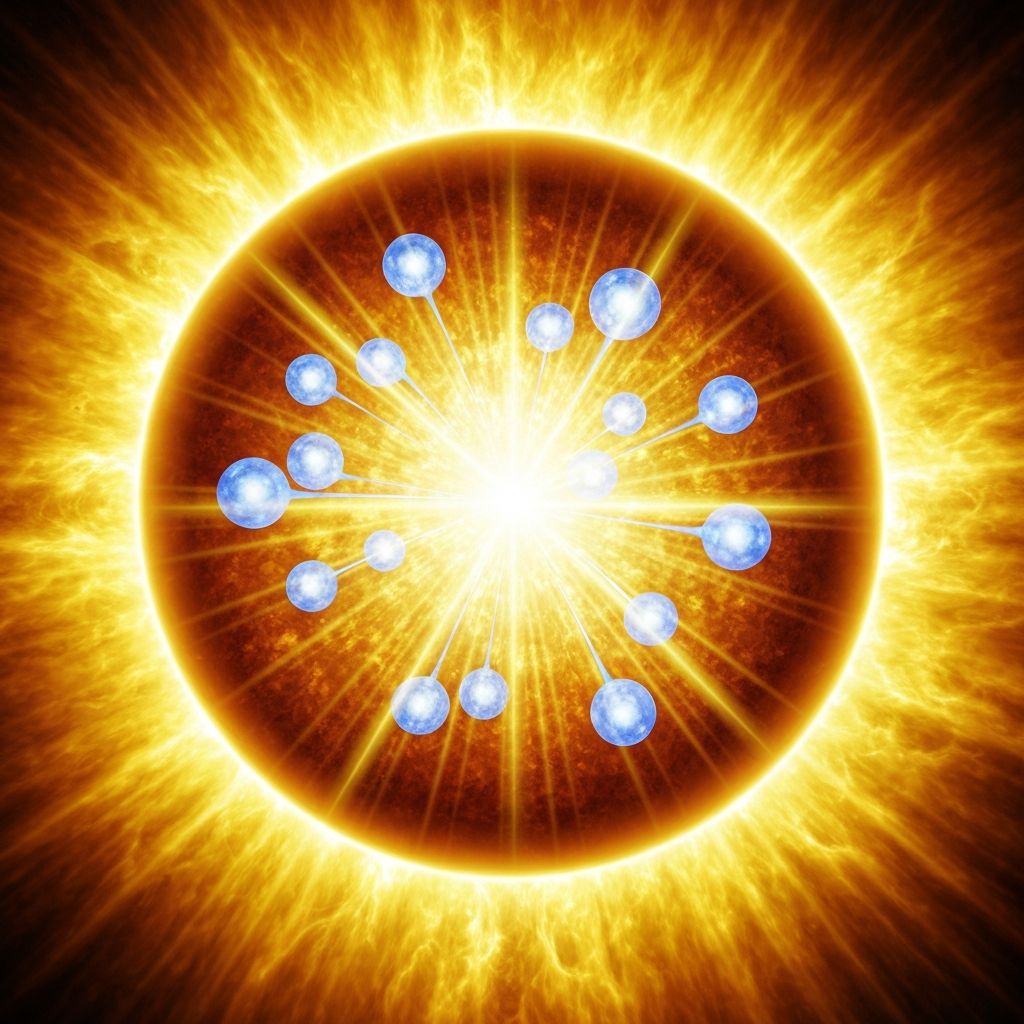
Fusing Atoms
The energy source that powers the Sun
Nuclear fusion is the process where two light nuclei join together to form a heavier nucleus, releasing enormous amounts of energy. This is the process that powers the Sun and all stars in the universe. The most common fusion fuels are the hydrogen isotopes deuterium (²H) and tritium (³H).
For fusion to occur, the nuclei must overcome their electrostatic repulsion - since both are positively charged, they naturally push apart. This requires extreme conditions: temperatures exceeding 100 million Kelvin on Earth (or about 15 million Kelvin in the Sun's core where immense pressure helps). At these temperatures, matter exists as plasma, a superheated state where electrons are stripped from atoms.
The classic fusion reaction combines deuterium and tritium: ²H + ³H → ⁴He + n + 17.6 MeV. The products (helium-4 plus a neutron) have slightly less mass than the original nuclei. This mass defect is converted directly to energy according to Einstein's famous equation E = mc². Remarkably, 1 kg of hydrogen fusion fuel releases energy equivalent to burning approximately 10 million kg of coal!
Fusion offers significant advantages over fission: higher energy density (about 4× more per kg), less radioactive waste, abundant fuel (hydrogen from water), and inherent safety since the reaction cannot "run away" in a chain reaction. However, the challenge lies in achieving and sustaining the extreme temperatures required. Projects like JET and ITER are working toward making fusion power commercially viable.
Explore fusion reactions, energy comparisons, and stellar fusion
Deuterium
Tritium
Two hydrogen nuclei (deuterium + tritium) approach
²₁H + ³₁H → ⁴₂He + ¹₀n + 17.6 MeV
Deuterium + Tritium → Helium-4 + Neutron + Energy
Complete the fusion equation and explain the energy release:
Step 1: Balance mass numbers (A): 2 + 3 = 5 total
Step 2: Balance atomic numbers (Z): 1 + 1 = 2 total
Step 3: Products must have A = 5 and Z = 2
Step 4: Helium-4 has A = 4, Z = 2. Remaining: A = 1, Z = 0 (neutron)
²₁H + ³₁H → ⁴₂He + ¹₀n + 17.6 MeV
The mass of products (4.0026 + 1.0087 = 5.0113 u) is less than reactants (2.0141 + 3.0160 = 5.0301 u). This mass defect of 0.0188 u converts to 17.6 MeV of energy.
TERM
Nuclear Fusion
Click to reveal definition
What is nuclear fusion?