Atomic Structure and Nuclear Composition
Explore the structure of atoms and understand how protons, neutrons, and electrons define elements and isotopes
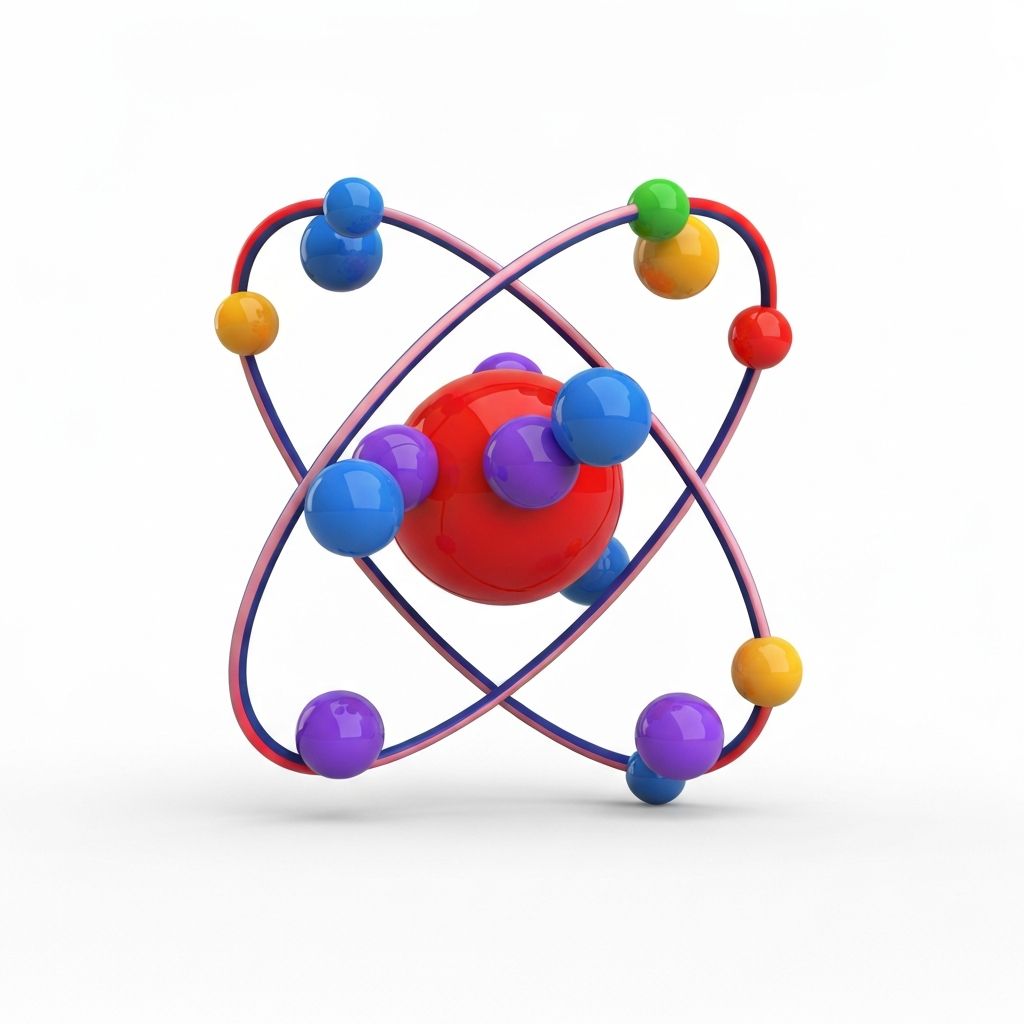
Inside the Atom
Protons, neutrons, and electrons
Every atom consists of a tiny, dense nucleus at its centre, surrounded by electronsorbiting in shells. The nucleus contains two types of particles: protons (positive charge) andneutrons (no charge). Together, protons and neutrons are called nucleons.
Electrons are negatively charged and have negligible mass compared to the nucleus. In a neutral atom, the number of electrons equals the number of protons, balancing the charges.
The atomic number (Z) is the number of protons in the nucleus. This defines which element an atom is—all carbon atoms have 6 protons, all oxygen atoms have 8 protons.
The mass number (A) is the total number of protons plus neutrons. Since electrons have negligible mass, the mass number tells us the approximate mass of the atom.
Number of neutrons = Mass number − Atomic number
N = A − Z
Isotopes are atoms of the same element with the same number of protons but different numbers of neutrons. For example, carbon-12 and carbon-14 are both carbon (6 protons), but carbon-14 has 2 extra neutrons.
We write isotopes using nuclide notation: the mass number (A) is written as a superscript and the atomic number (Z) as a subscript, followed by the element symbol. For example, uranium-238 is written as 23892U.
Relative Sizes
The nucleus (~10⁻¹⁵ m) is about 100,000 times smaller than the atom (~10⁻¹⁰ m). If an atom were the size of a football stadium, the nucleus would be the size of a pea!
Select Element:
Mass Number (A): 12
Nuclide Notation
Mass number (A) = 12
Atomic number (Z) = 6
Particle Count
Atom Model (Not to Scale)
About This Isotope
Carbon-12 has 6 protons and 6 neutrons in its nucleus, with 6 electrons orbiting in shells. The notation 126C shows the mass number (top) and atomic number (bottom).
Nucleus
Question:
The nuclide notation for an isotope of chlorine is 3717Cl. Determine the number of protons, neutrons, and electrons in a neutral atom.
Answer:
From the notation: Mass number (A) = 37, Atomic number (Z) = 17
Protons = Atomic number = 17
Neutrons = Mass number − Atomic number = 37 − 17 = 20
Electrons = Protons (in neutral atom) = 17
What particles are found in the nucleus of an atom?