Half-life Applications and Safety
Explore how half-life is used in medicine, dating, and understand radiation safety
Half-life in Action
From medicine to archaeology
Half-lives vary enormously: uranium-238 has a half-life of 4.5 billion years, whilepolonium-214 has a half-life of just 160 microseconds. This huge range makes different isotopes useful for different applications.
The formula for calculating remaining nuclei is:
N = N₀ × (½)^(t/T)
N = remaining, N₀ = initial, t = time, T = half-life
Radioactive isotopes have many medical uses:
- Iodine-131 (half-life: 8 days): Treats thyroid cancer. The thyroid absorbs iodine, so radioactive iodine targets thyroid cells.
- Technetium-99m (half-life: 6 hours): Used as a tracer in medical imaging. Its short half-life means quick decay and minimal patient exposure.
- Cobalt-60: Gamma rays sterilize medical equipment without heat.
- PET scanning: Uses positron emitters to create detailed body images.
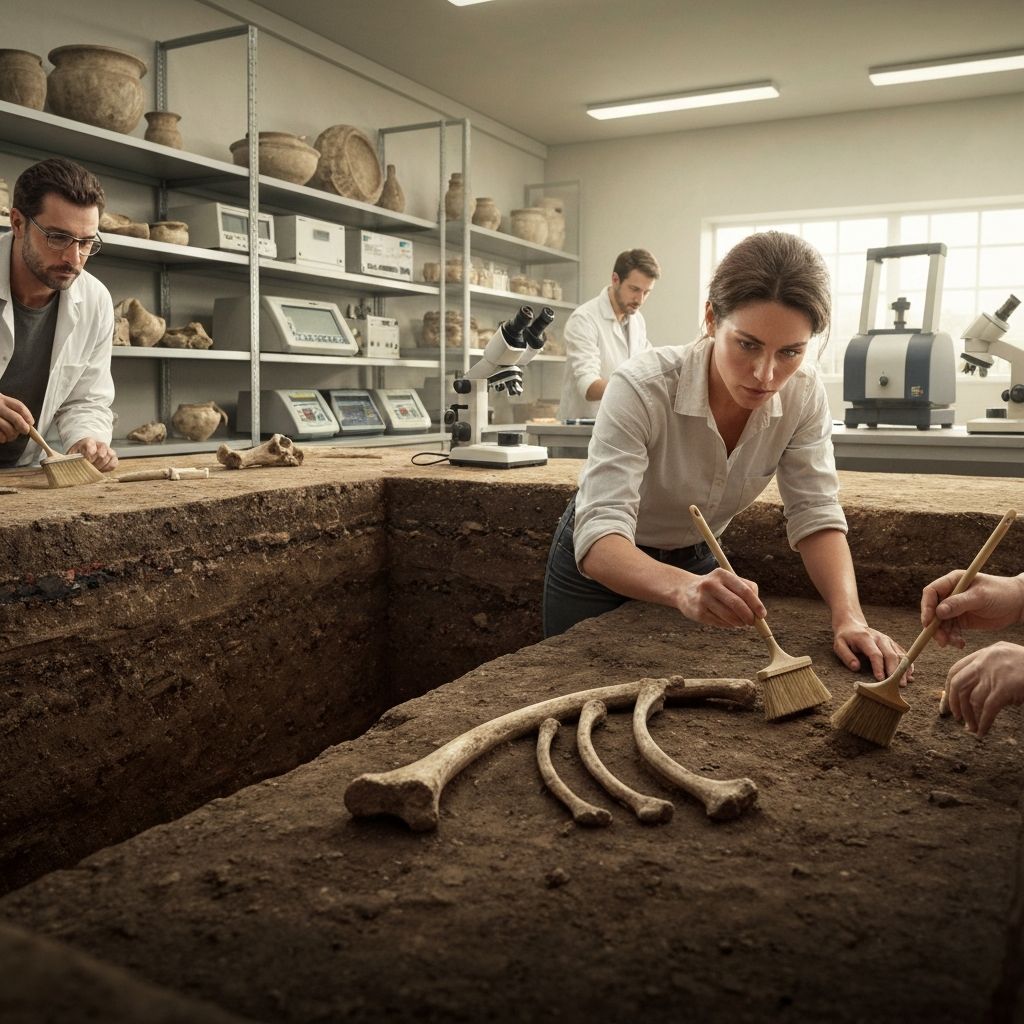
Carbon-14 dating works for organic materials up to about 60,000 years old. Living organisms absorb C-14 from the atmosphere. When they die, the C-14 decays with a half-life of 5,730 years. By measuring remaining C-14, we calculate when the organism died.
For older materials like rocks, potassium-40 dating (half-life: 1.3 billion years) oruranium-238 dating (half-life: 4.5 billion years) is used.
Three key safety principles:
- Shielding: Alpha stopped by paper, beta by aluminium, gamma needs thick lead
- Distance: Intensity decreases with distance squared—doubling distance quarters the intensity
- Time: Minimize exposure time to reduce total dose received
Danger Assessment
Short half-life = high activity = dangerous for short exposures but decays quickly.
Long half-life = low activity = less immediately dangerous but persists for a long time.
Calculation
N = N₀ × (½)^(t/T)
N = 1000 × (½)^(30/10)
N = 1000 × (½)^3.000
N = 125.00 nuclei remaining
Remaining
125
Decayed
875
Half-lives
3.00
Decay Curve
Half-life
Question:
A wooden artifact has 25% of its original carbon-14 remaining. The half-life of C-14 is 5,730 years. How old is the artifact?
Answer:
25% remaining = ¼ = (½)²
This means 2 half-lives have passed.
Age = 2 × 5,730 = 11,460 years old
A sample has a half-life of 6 hours. What fraction remains after 18 hours?