Nuclear Risks, Waste, and Safety
Radiation hazards, waste disposal, accidents, and risk assessment
Nuclear Risks, Waste, and Safety
Radiation hazards, waste disposal, accidents, and risk assessment
Ionizing radiation (alpha, beta, gamma, X-rays, neutrons) damages DNA and cells, potentially causing cancer, mutations, and radiation sickness. Alpha particles are stopped by paper or skin but are extremely dangerous if inhaled or ingested. Beta particlespenetrate skin but are stopped by about 1cm of aluminum. Gamma rays are highly penetrating, requiring thick lead or concrete for effective shielding.
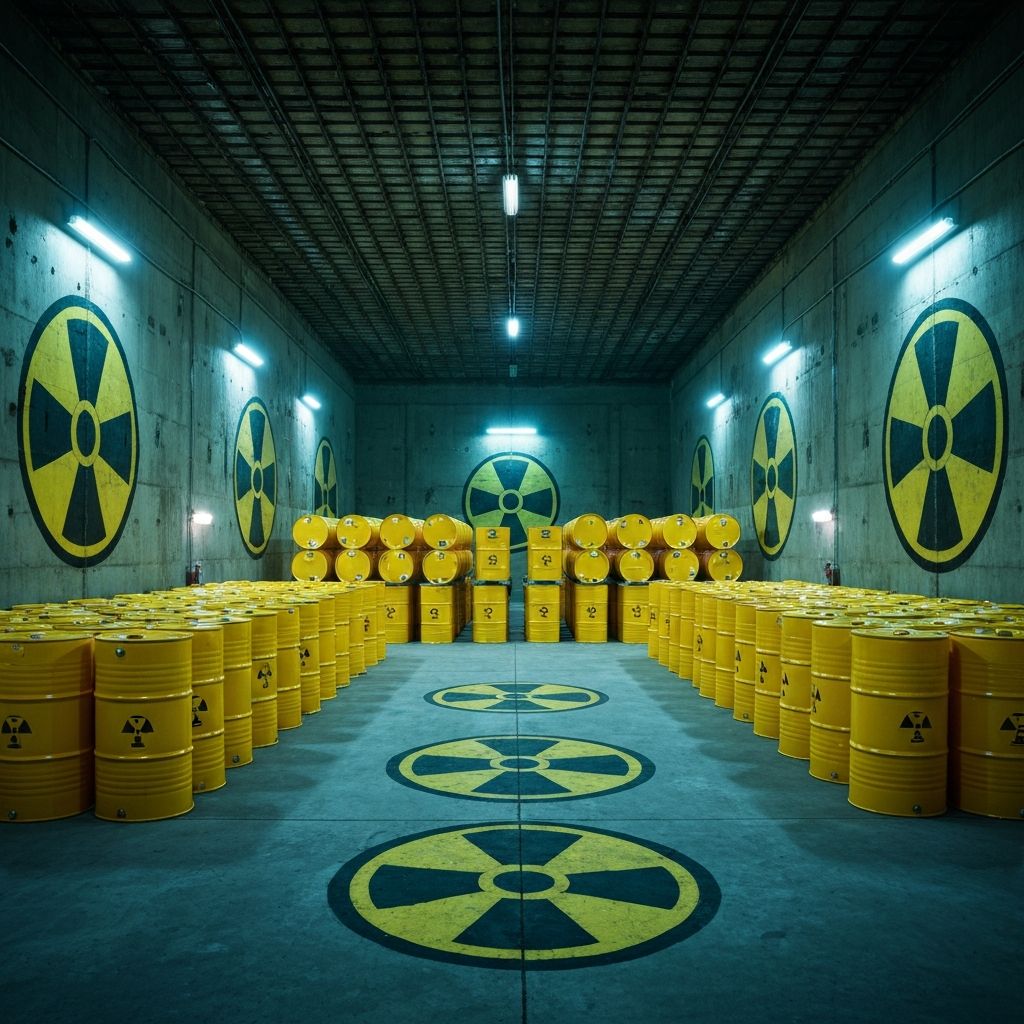
Nuclear waste is categorized by radioactivity level: high-level waste (spent fuel rods) remains dangerous for thousands of years, while low-level waste (contaminated tools, clothing) has shorter half-lives. The challenge is isolating waste from the environment for millennia using deep geological repositories like Finland's Onkalo facility.
Three major reactor accidents shape nuclear safety today: Three Mile Island (1979) showed containment buildings work, Chernobyl (1986) demonstrated catastrophic consequences of design flaws and operator error, and Fukushima (2011) highlighted tsunami/natural disaster vulnerabilities. Modern reactors use multiple containment barriers and redundant safety systems.
Risk analysis shows nuclear power has one of the lowest death rates (0.03 per TWh vs coal's 24.6) and lowest carbon emissions (12g CO2/GWh). The main challenges are long-term waste storage, accident risk perception, and high construction costs.
Stopped by paper or skin. Dangerous if inhaled/ingested.
Penetrates skin, stopped by ~1cm aluminum.
Highly penetrating. Requires thick lead or concrete.
Problem:
High-level nuclear waste has an initial activity of 10,000,000 Bq. If the half-life is 30 years (like Caesium-137), how long until it reaches a "safe" level of approximately 10,000 Bq?
Solution:
Step 1: Find how many half-lives needed
Initial ÷ 2^n = Final
10,000,000 ÷ 2^n = 10,000
2^n = 1,000
n = log2(1000) ≈ 10 half-lives
Step 2: Calculate total time
Time = 10 × 30 years = 300 years
Note: Some isotopes like Plutonium-239 (half-life 24,000 years) require storage for hundreds of thousands of years, which is why deep geological repositories are essential.
Term
Ionizing Radiation
Click to reveal definition
Which type of radiation is most dangerous if inhaled or ingested?