The Solar System and Gravitational Fields
Explore planetary orbits, Newton's law of gravitation, and orbital mechanics
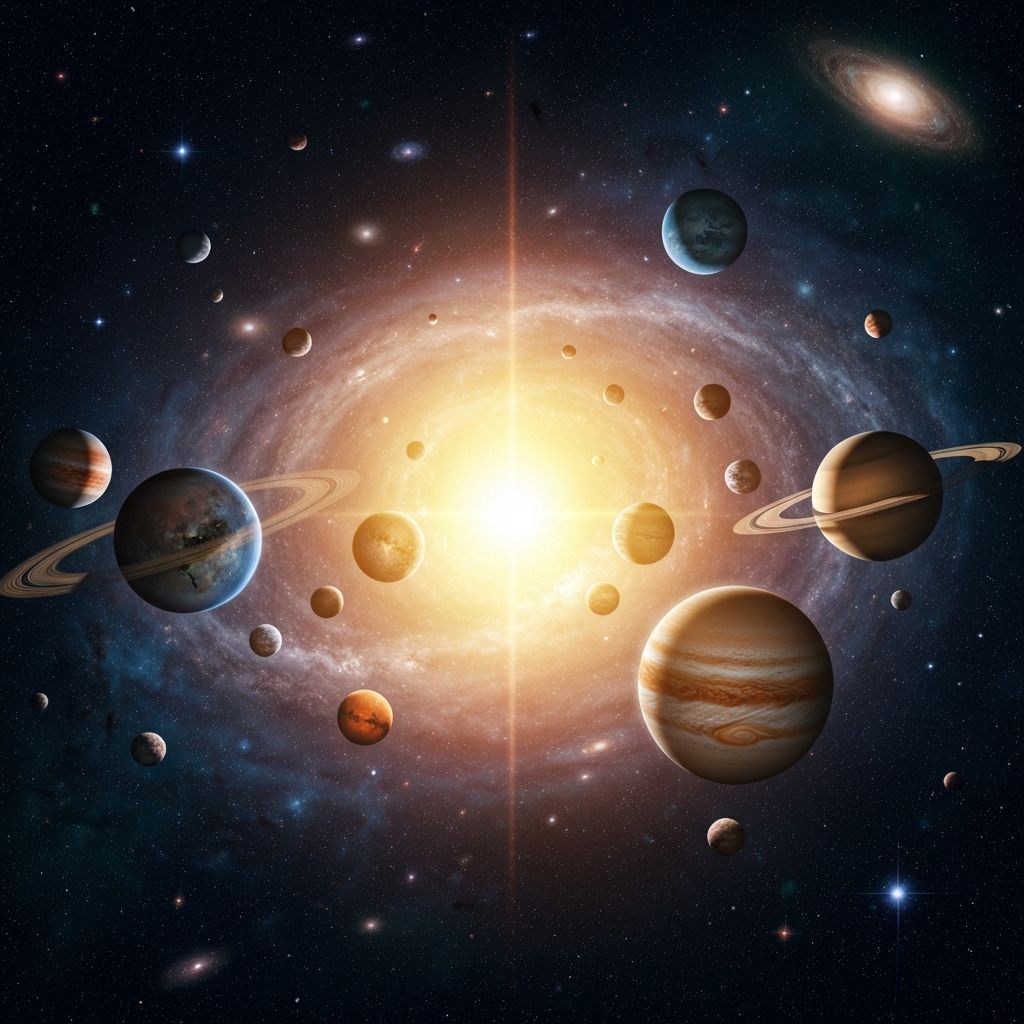
Our Solar System
Eight planets held in orbit by gravity
Our Solar System consists of the Sun at its center, surrounded by eight planets, their moons, asteroids, and comets. The planets, in order from the Sun, are: Mercury, Venus, Earth, Mars (inner rocky planets), then Jupiter, Saturn, Uranus, Neptune (outer gas giants).
All planets travel in approximately elliptical orbits (nearly circular) around the Sun. The Sun's enormous mass creates a gravitational field—a region where objects experience an attractive force toward the Sun.
Gravitational field strength (g) is the force per unit mass experienced by an object in a gravitational field, measured in N/kg (equivalent to m/s²).
Newton's Law of Gravitation: F = GMm/r²
Field strength: g = GM/r²
The inverse square law means that doubling the distance reduces gravitational force to one quarter. This is why astronauts in orbit experience "weightlessness"—not because there's no gravity, but because they're in continuous freefall.
Gravity provides the centripetal force needed to keep planets moving in circular paths. Without it, planets would fly off in straight lines (Newton's first law).
Orbital Speed
v = √(GM/r)
Orbital Period
T = 2π√(r³/GM)
Kepler's Third Law states that T² ∝ r³—planets further from the Sun take longer to complete one orbit, with period increasing faster than distance.
Earth
Solar System
Question:
Calculate the orbital speed of Earth around the Sun. (Distance = 1.5 × 10¹¹ m, Sun's mass = 2 × 10³⁰ kg, G = 6.67 × 10⁻¹¹ N m²/kg²)
Answer:
v = √(GM/r)
v = √(6.67 × 10⁻¹¹ × 2 × 10³⁰ / 1.5 × 10¹¹)
v = √(8.89 × 10⁸)
v = 29,800 m/s ≈ 30 km/s
What provides the centripetal force that keeps planets in orbit around the Sun?