Addition Polymers
Understand how alkenes join to form long polymer chains and their environmental impact
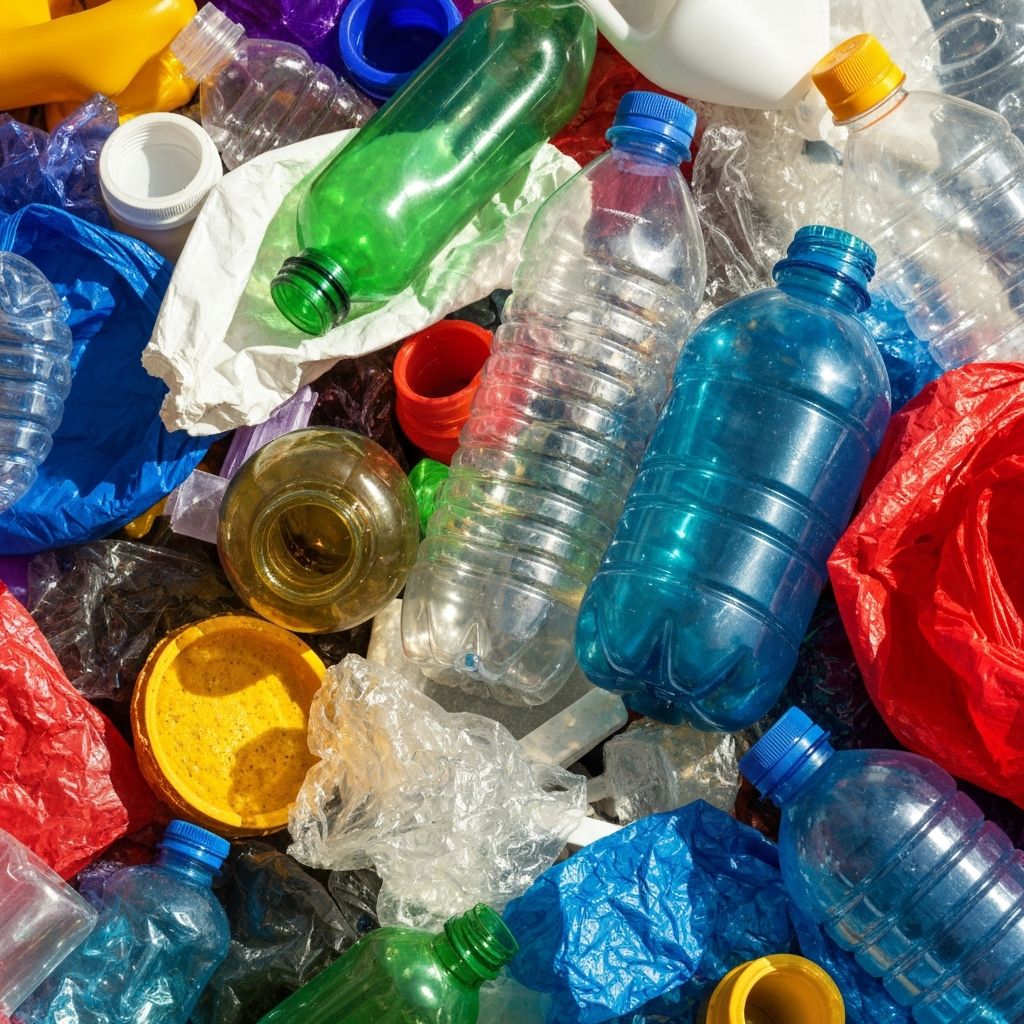
Polymers Everywhere
From monomers to everyday plastics
Polymers are long-chain molecules made of many repeating units called monomers. In addition polymerisation, many alkene molecules join together by opening their C=C double bonds. No atoms are lost in this process – the monomer formula equals the repeating unit formula.
The process works because alkenes are unsaturated. When the double bond opens, each carbon can form a new bond with the carbon of an adjacent monomer, creating a long chain. Thousands or millions of monomers can join in this way.
Key Exam Point
To draw a polymer from its monomer: remove the double bond, add single bonds on each side, and put brackets around the unit with subscript 'n'. Example: CH₂=CH₂ becomes ( -CH₂-CH₂- )ₙ
Poly(ethene) is made from ethene (C₂H₄). It exists as LDPE (low-density, flexible – plastic bags) and HDPE (high-density, rigid – bottles, containers). The difference is in how the chains are arranged.
Poly(propene) is made from propene (C₃H₆). It's stronger than poly(ethene) and is used for car bumpers, packaging, and rope.
Poly(chloroethene) or PVC is made from chloroethene (C₂H₃Cl). It's used for pipes, flooring, and window frames. It's strong, rigid, and resistant to chemicals.
Monomer: Ethene
Double bond ready to open
Polymer: Poly(ethene)
( -CH₂-CH₂- )ₙUses: Plastic bags, bottles (LDPE/HDPE)
Monomers Ready
Double bonds shown between carbon atoms
Note: Addition polymers are non-biodegradable. They persist in the environment for hundreds of years. Recycling involves melting and reshaping, or chemical breakdown to monomers.
Addition polymers are non-biodegradable – microorganisms cannot break them down. They persist in the environment for hundreds of years, accumulating in landfills and oceans.
Burning polymers releases energy but can produce toxic fumes, especially if the polymer contains halogens (like PVC, which releases hydrogen chloride gas).
Recycling helps reduce waste. Mechanical recycling involves melting and reshaping polymers. Chemical recycling breaks polymers back into monomers that can be used to make new polymers.
Question:
Draw the repeating unit for poly(propene) from the monomer propene (CH₂=CH-CH₃) and explain why it is non-biodegradable.
Answer:
Monomer: CH₂=CH-CH₃ (propene)
Repeating unit:
( -CH₂-CH(CH₃)- )ₙThe C=C double bond opens, and each carbon forms a bond to the adjacent monomer. The CH₃ group remains attached to one carbon.
Why non-biodegradable: The C-C bonds in the polymer backbone are very strong and unreactive. Microorganisms do not have enzymes capable of breaking these bonds, so the polymer cannot be decomposed naturally.
What is a polymer?