Crude Oil and Fractional Distillation
Learn how crude oil is separated into useful fractions by boiling point
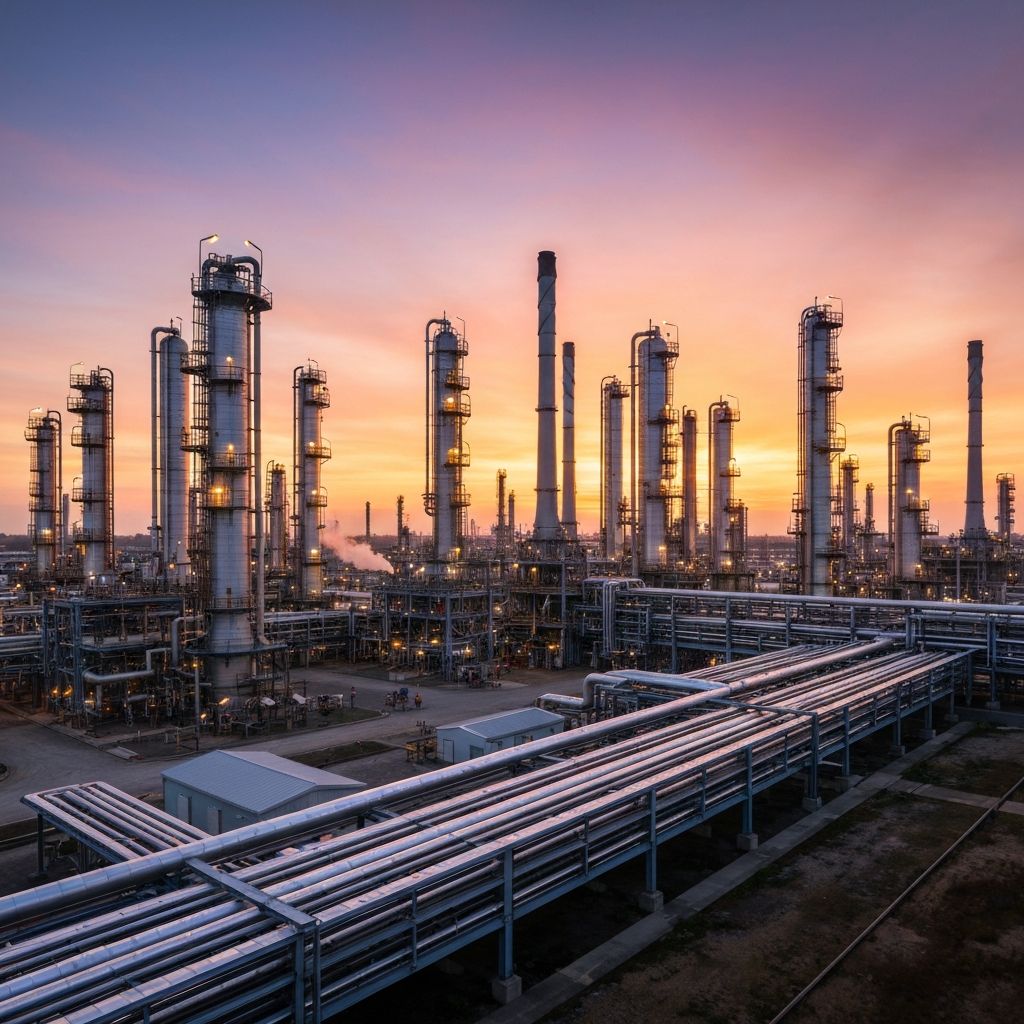
Separating the Mixture
From crude oil to useful products
Crude oil is a fossil fuel formed over millions of years from the remains of ancient marine organisms like plankton. It is a complex mixture of hydrocarbons with different chain lengths, ranging from very short molecules (1-4 carbons) to very long ones (70+ carbons). Because it's a mixture, crude oil has no fixed boiling point.
To make crude oil useful, it must be separated into fractions—groups of hydrocarbons with similar boiling points and chain lengths. This is done using fractional distillation, which exploits the fact that different sized molecules boil at different temperatures.
Key Exam Point
Longer hydrocarbon chains have higher boiling points because they have stronger intermolecular forces (van der Waals forces). More surface area means more contact between molecules, requiring more energy to separate them.
Crude oil is heated to approximately 350°C in a furnace, turning most of it into vapour. This vapour enters the bottom of a tall fractionating column, which is hot at the bottom and cooler at the top. As vapours rise, they cool and condense at different heights.
Short chain hydrocarbons have low boiling points, so they rise to the top before condensing. Long chain hydrocarbons condense lower down where it's hotter. The heaviest molecules don't vaporise at all and remain as residue (bitumen) at the bottom.
The main fractions, from top to bottom, are: petroleum gas (C1-C4), petrol/gasoline (C5-C12), kerosene (C11-C18), diesel (C15-C25), fuel oil (C25-C70), and bitumen (C70+). Each has specific uses based on its properties.
Current: 200°C
As chain length increases: boiling point increases (stronger intermolecular forces), viscosity increases (thicker, harder to pour), flammability decreases (harder to ignite), and colour becomes darker. These trends explain why different fractions suit different purposes.
Short chain fractions like petrol are highly flammable and flow easily, making them ideal fuels. Long chain fractions like bitumen are not flammable and are solid at room temperature, suitable for construction materials.
Question:
Explain why diesel has a higher boiling point than petrol.
Answer:
Diesel contains longer hydrocarbon chains (C15-C25) compared to petrol (C5-C12).
Longer chains have more surface area, which means more points of contact between molecules.
This creates stronger van der Waals forces (intermolecular forces) between molecules.
More energy is needed to overcome these forces and separate the molecules, so diesel has a higher boiling point (300-370°C vs 40-200°C).
What is crude oil?