Ionic Bonding
Understand how metals and non-metals transfer electrons to form ionic compounds
Electron Transfer
Forming Ions and Ionic Compounds
Ionic bonding is the strong electrostatic attraction between positively charged metal ions and negatively charged non-metal ions. It occurs when electrons are transferred from a metal atom to a non-metal atom, creating oppositely charged particles that attract each other.
When a metal atom loses electrons, it becomes a positively charged ion called a cation. When a non-metal atom gains electrons, it becomes a negatively charged ion called an anion. The opposite charges attract strongly, holding the ions together in an ionic bond.
For example, sodium (Na) has 1 electron in its outer shell, which it loses to form Na⁺. Chlorine (Cl) has 7 outer electrons and gains 1 to form Cl⁻ with a full outer shell. The Na⁺ and Cl⁻ ions attract to form sodium chloride (NaCl).
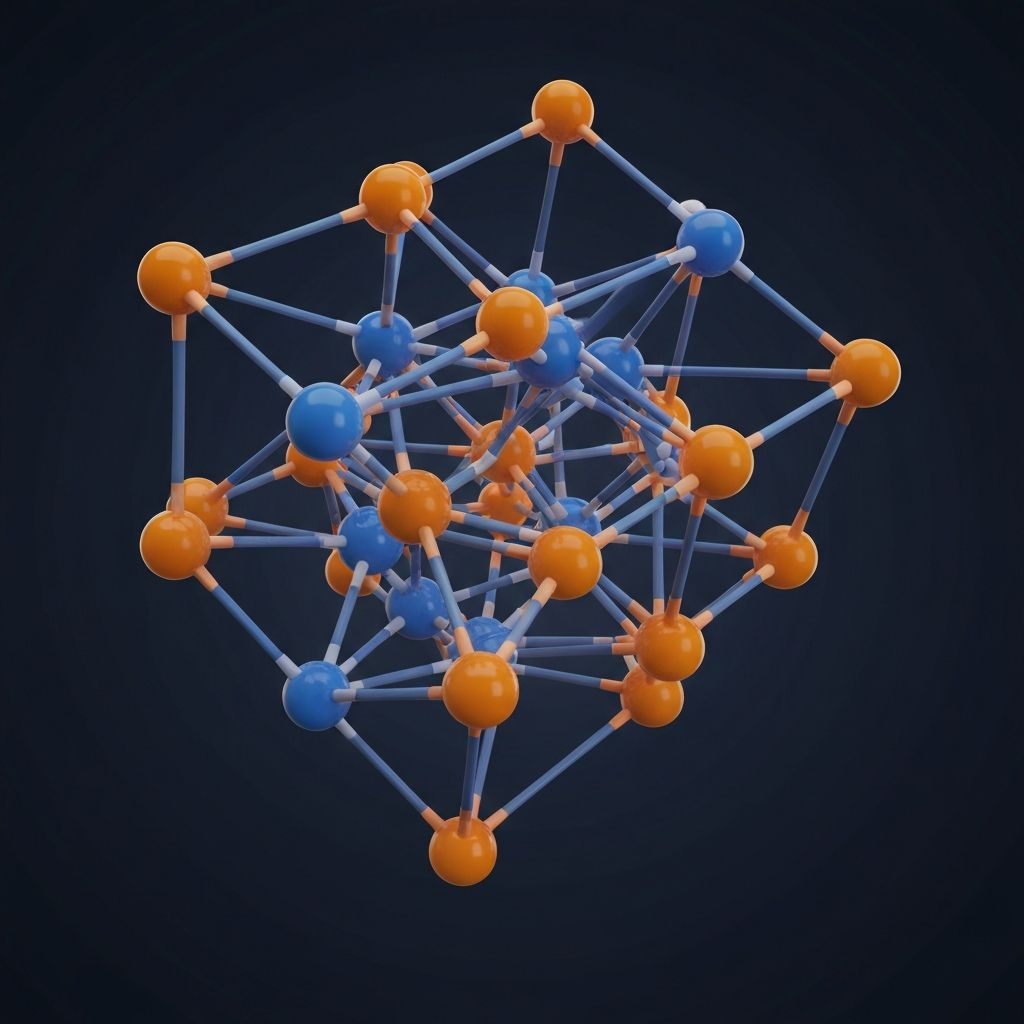
Ionic compounds don't exist as individual molecules. Instead, billions of positive and negative ions arrange themselves into a regular three-dimensional pattern called a giant ionic lattice. Each ion is surrounded by ions of opposite charge, maximising the attractive forces.
This structure explains the properties of ionic compounds. The strong electrostatic forces throughout the lattice mean ionic compounds have high melting and boiling points—lots of energy is needed to break the bonds between ions.
Starting atoms (before electron transfer)
Sodium
1 valence electron(s)
Chlorine
7 valence electron(s)
Sodium loses 1 electron to form Na⁺. Chlorine gains 1 electron to form Cl⁻. The oppositely charged ions attract.
Electrical conductivity: Ionic compounds conduct electricity when molten or dissolved in water because the ions are free to move and carry charge. When solid, ions are fixed in the lattice and cannot move, so solid ionic compounds do not conduct.
Brittleness: Ionic compounds are brittle—they shatter when hit. When a force is applied, layers of ions shift. This brings ions of the same charge next to each other, and the repulsion causes the crystal to break apart.
Solubility: Many ionic compounds dissolve in water. Water molecules surround the ions and separate them from the lattice. The positive end of water molecules attracts anions, while the negative end attracts cations.
Ionic Bonding
Click to reveal definition
Question:
Describe the formation of magnesium oxide (MgO). State the charges on each ion and explain why MgO has a high melting point.
Solution:
Step 1 - Electron configuration: Magnesium has 2 outer electrons (2,8,2). Oxygen has 6 outer electrons (2,6).
Step 2 - Electron transfer: Magnesium loses 2 electrons to form Mg²⁺. Oxygen gains 2 electrons to form O²⁻. Both ions now have full outer shells.
Step 3 - Ion charges: Mg²⁺ (2+ charge) and O²⁻ (2- charge).
Step 4 - Explain high melting point: MgO has a very high melting point (2852°C) because of the strong electrostatic attraction between the Mg²⁺ and O²⁻ ions. The ions have higher charges (2+ and 2-) than in NaCl (1+ and 1-), so the attraction is stronger. A large amount of energy is needed to overcome these forces.
What type of particles are involved in ionic bonding?