The Periodic Table
Understand the organisation of elements and how their position determines their properties
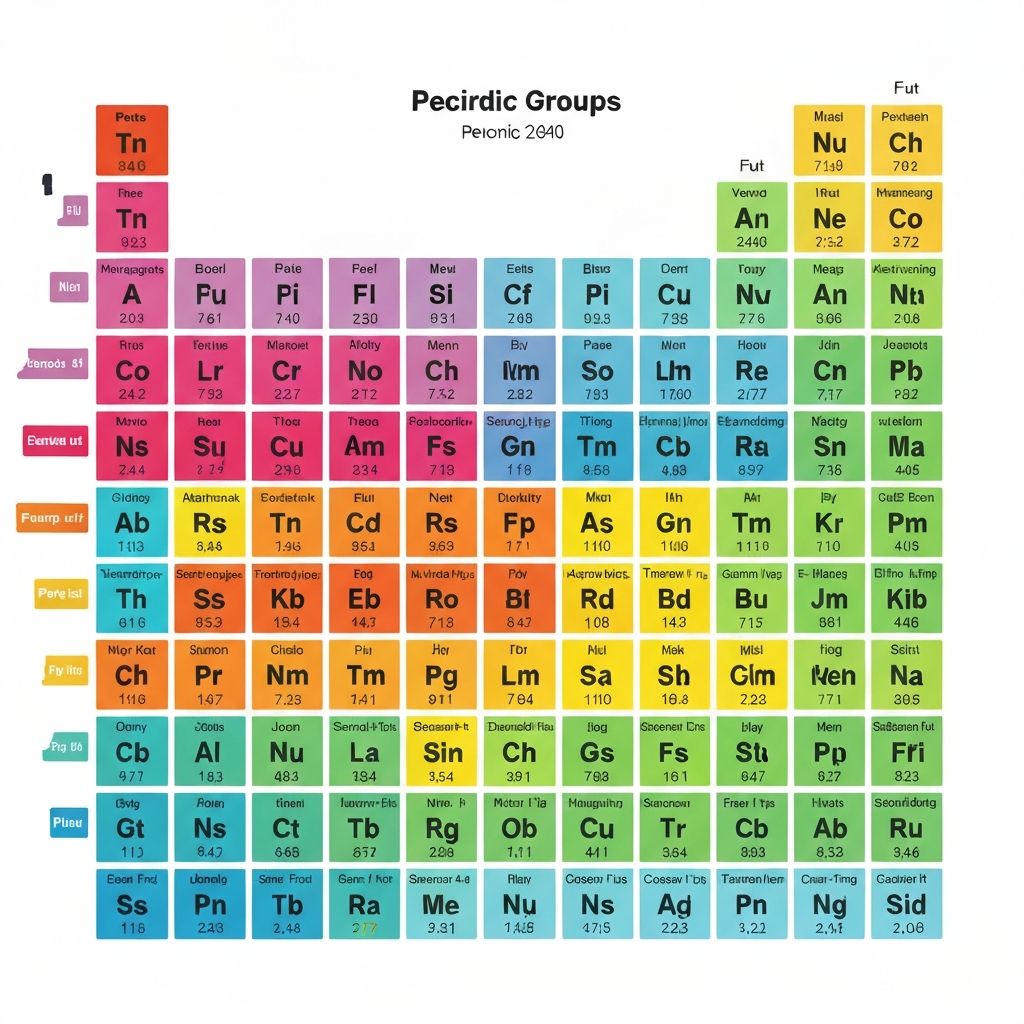
Element Organisation
Groups, Periods, and Trends
The periodic table arranges all known elements by increasing atomic number (number of protons). Elements are placed in horizontal rows called periods and vertical columns called groups. This arrangement reveals patterns in physical and chemical properties.
Periods represent the number of electron shells an atom has. Elements in Period 1 have one shell, Period 2 elements have two shells, and so on. As you move down the table, atoms become larger because they have more electron shells.
Groups indicate the number of valence electrons (outer shell electrons). Elements in the same group have identical numbers of valence electrons, giving them similar chemical properties. Group 1 elements all have 1 valence electron; Group 7 elements all have 7 valence electrons.
Group 1 (Alkali Metals): Lithium (Li), sodium (Na), potassium (K) are soft, shiny metals with 1 valence electron. They are extremely reactive, especially with water and oxygen. Reactivity increases down the group because the outer electron is further from the nucleus and easier to lose.
Group 7 (Halogens): Fluorine (F), chlorine (Cl), bromine (Br), iodine (I) are reactive non-metals with 7 valence electrons. They exist as diatomic molecules (F₂, Cl₂, Br₂, I₂) and need only one more electron to complete their outer shell. Reactivity decreases down the group.
Group 0 (Noble Gases): Helium (He), neon (Ne), argon (Ar) are unreactive gases with full outer shells (8 valence electrons, or 2 for helium). Their stable electron configuration means they don't need to gain or lose electrons, making them chemically inert.
Transition Metals: Located in the middle block, these metals (iron, copper, zinc) have variable valency, form coloured compounds, and often act as catalysts. They are generally less reactive than Group 1 metals.
Metals are found on the left and centre of the periodic table. They are good conductors of heat and electricity, shiny (lustrous), malleable (can be hammered into shape), and ductile (can be drawn into wires). Metals lose electrons to form positive ions.
Non-metals are found on the right side of the table. They are poor conductors (except graphite), dull, brittle, and gain electrons to form negative ions. Examples include oxygen, nitrogen, and sulfur.
Metalloids (semi-metals) such as silicon and boron are found along the diagonal boundary. They have properties of both metals and non-metals and are crucial in semiconductor technology.
Click on any element to view its properties and electron configuration
Question:
An unknown element X is in Group 2, Period 3 of the periodic table. Predict its properties and identify the element.
Solution:
Step 1 - Valence electrons: Group 2 means element X has 2 valence electrons.
Step 2 - Electron shells: Period 3 means it has 3 electron shells.
Step 3 - Electron configuration: 2, 8, 2 (filling shells with 2, then 8, then 2).
Step 4 - Properties: Group 2 elements are alkaline earth metals. Element X will be a shiny metal, moderately reactive, form 2+ ions by losing 2 electrons, and conduct electricity.
Answer: Element X is magnesium (Mg), atomic number 12.
What does the group number tell you about an element?