Atomic Structure
Explore the fundamental structure of atoms and understand how subatomic particles determine an element's properties
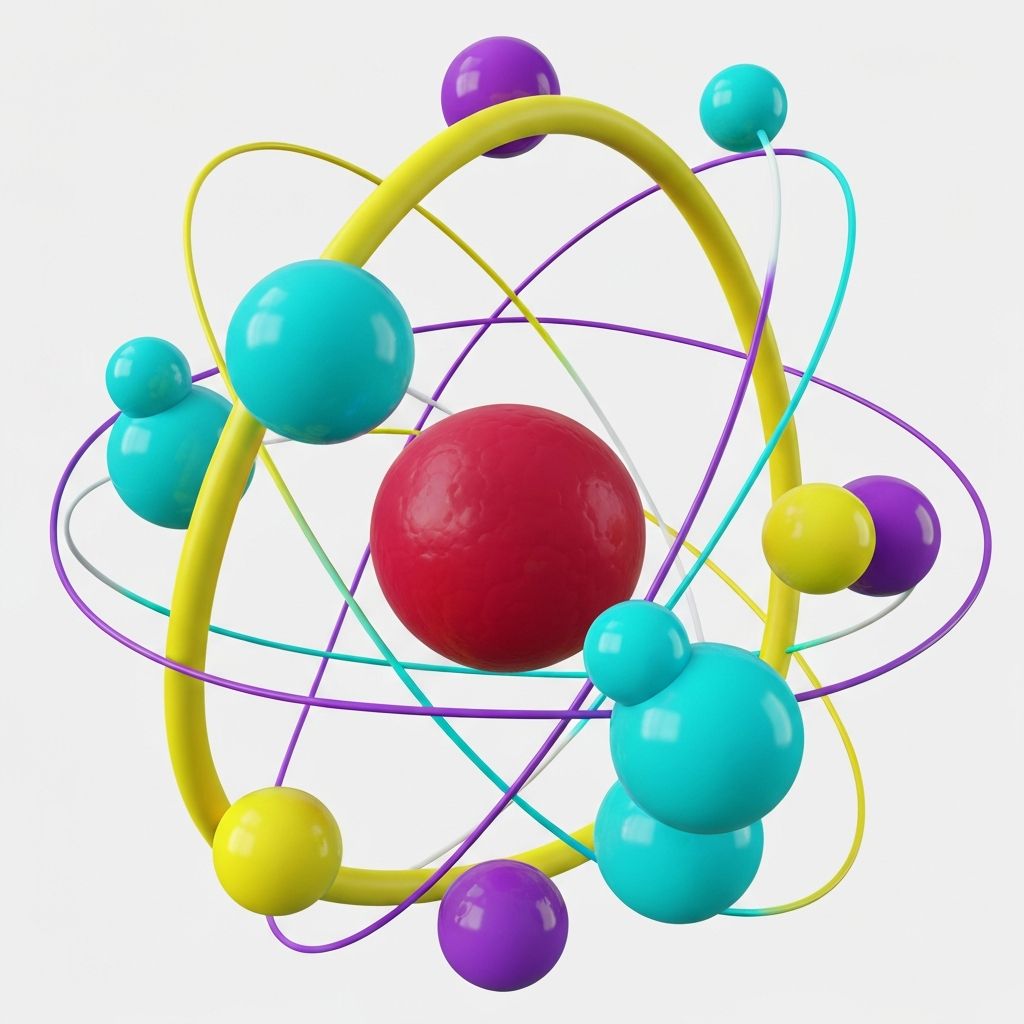
Inside the Atom
Protons, Neutrons, and Electrons
Every atom consists of a dense central nucleus containing protons and neutrons, surrounded by electrons that orbit in specific energy levels called electron shells. Understanding this structure is fundamental to explaining how elements behave and interact.
Protons are positively charged particles (charge +1) with a relative mass of 1, found in the nucleus. The number of protons determines which element the atom is—this is called the atomic number (Z). For example, all carbon atoms have exactly 6 protons.
Neutrons have no electrical charge (0) and also have a relative mass of 1. They sit in the nucleus alongside protons. Atoms of the same element can have different numbers of neutrons, creating isotopes—variants with different mass numbers but identical chemical properties.
Electrons are negatively charged particles (charge -1) with negligible mass, orbiting the nucleus in shells. The first shell can hold up to 2 electrons, the second and third can hold 8 each, following the pattern 2, 8, 8, 18... In a neutral atom, the number of electrons equals the number of protons, balancing the charges.
The mass number (A) is the sum of protons and neutrons in an atom's nucleus. For instance, carbon-12 has 6 protons and 6 neutrons (mass number 12), while carbon-14 has 6 protons and 8 neutrons (mass number 14)—these are isotopes of carbon.
When atoms gain or lose electrons, they become ions—charged particles. Losing electrons creates a positive ion (cation), while gaining electrons creates a negative ion (anion). The relative atomic mass accounts for the weighted average of all naturally occurring isotopes of an element.
Element
Carbon
Atomic Number (Z)
6
Mass Number (A)
12
Electron Configuration
2, 4
Charge
0 (Neutral)
Tip: Adjust protons to change the element, neutrons to create isotopes, and electrons to form ions. Notice how the electron shells fill up following the 2, 8, 8 pattern!
Electrons are arranged in shells around the nucleus, filling from the innermost shell outward:
Hydrogen (H)
Atomic number: 1
Electronic structure: 1
1 electron in first shell
Carbon (C)
Atomic number: 6
Electronic structure: 2, 4
2 in first shell, 4 in second shell
Oxygen (O)
Atomic number: 8
Electronic structure: 2, 6
2 in first shell, 6 in second shell
Chlorine (Cl)
Atomic number: 17
Electronic structure: 2, 8, 7
Shells fill in 2, 8, 8 pattern
Question:
An atom of aluminium has an atomic number of 13 and a mass number of 27. Determine:
- The number of protons
- The number of neutrons
- The number of electrons
- The electron configuration
Solution:
1. Number of protons:
The atomic number (Z) equals the number of protons = 13 protons
2. Number of neutrons:
Mass number (A) = protons + neutrons
27 = 13 + neutrons
Neutrons = 27 - 13 = 14 neutrons
3. Number of electrons:
In a neutral atom, electrons = protons = 13 electrons
4. Electron configuration:
Following the 2, 8, 8 pattern for 13 electrons:
First shell: 2, Second shell: 8, Third shell: 3
Electronic structure: 2, 8, 3
What is the charge of a proton?