Static Electricity and Electric Fields
Understanding charge, fields, and electrostatic applications
Static Electricity and Electric Fields
Charge, fields, and applications
Static electricity is the buildup of electric charge on objects. Charge is created by friction when electrons transfer between materials. There are two types of charge: positive (lost electrons) and negative (gained electrons). Like charges repel, opposite charges attract.
Electric charge is measured in Coulombs (C). The elementary charge e = 1.6 × 10⁻¹⁹ C is the charge of a single electron or proton. Charge is quantized (comes in integer multiples of e) and conserved (total charge stays constant).
Insulators (plastic, glass) hold static charge because electrons cannot move freely. Conductors (metals) allow charge to flow. Charging by induction occurs when a charged object near a conductor causes charge separation without contact.
An electric field is the region around a charged object where forces act on other charges. Coulomb's Law (F = kq₁q₂/r²) describes the force between two charges, where k = 9 × 10⁹ N·m²/C². Electric field strength E = F/q measures force per unit charge (N/C).
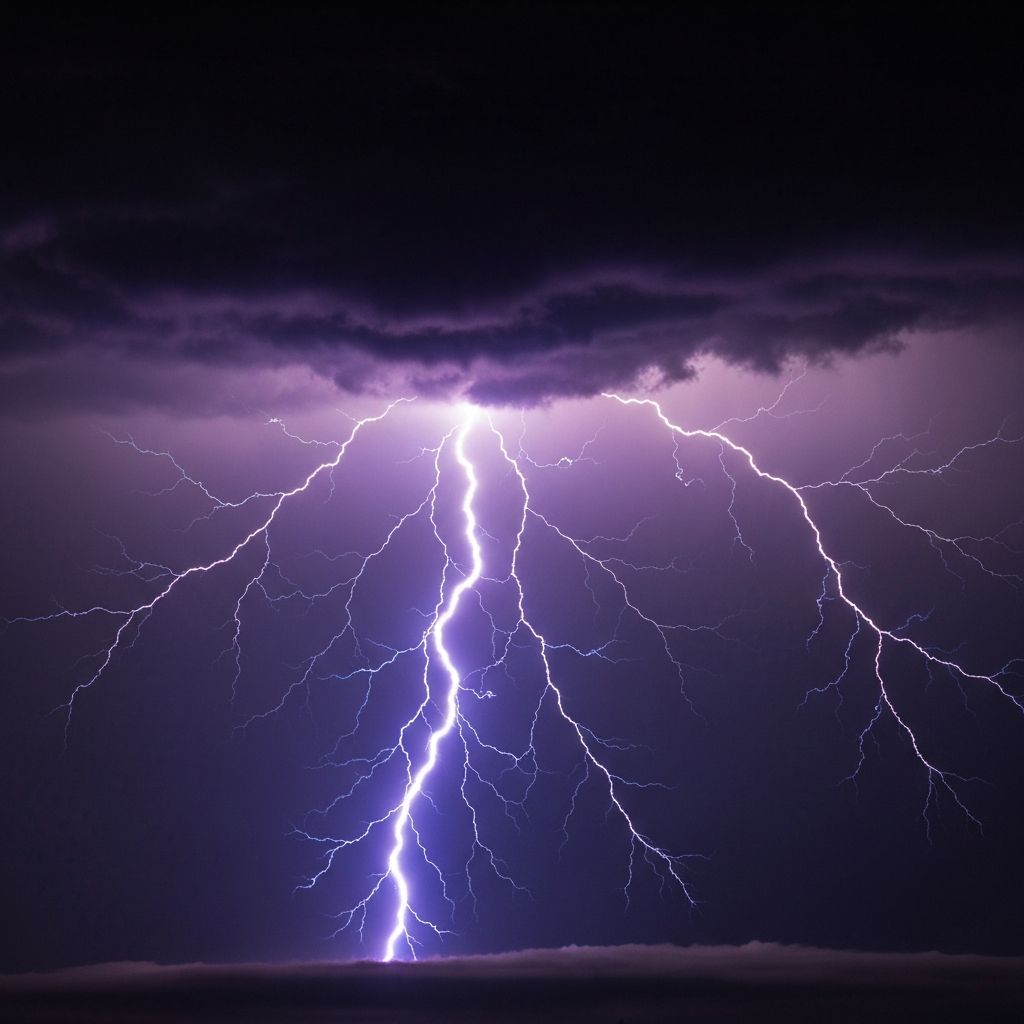
Static electricity has important applications: photocopiers use charged drums to attract toner, spray painting uses charge to attract paint droplets, and dust precipitators remove particles from air. However, static poses hazards: lightning strikes, fuel explosions from sparks, and ESD damage to electronics. Earthing/grounding prevents dangerous charge buildup by providing a path for charge to flow safely to ground.
What happens: Rubbing transfers electrons from cloth to balloon. The cloth loses electrons (becomes +), balloon gains electrons (becomes −).
Example 1: Charge Transfer
A balloon rubbed on wool gains electrons and becomes negatively charged. The wool loses electrons and becomes positively charged. When brought near each other, they attract (opposite charges). When the balloon is held near a wall (neutral), it polarizes the wall surface and attracts to it.
Example 2: Coulomb's Law Calculation
Two charges: q₁ = +2 × 10⁻⁶ C, q₂ = -3 × 10⁻⁶ C, separated by 0.1 m.
F = kq₁q₂/r² = (9×10⁹)(2×10⁻⁶)(3×10⁻⁶)/(0.1)² = 5.4 N
The force is attractive (toward each other) because the charges are opposite.
Example 3: Aircraft Refueling Safety
Aircraft refueling creates static charge from fuel flow through pipes. If not grounded, a spark could ignite fuel vapors, causing an explosion. A grounding wire connects the aircraft to ground, continuously draining charge to earth, preventing dangerous buildup.
Term
Static Electricity
Click to reveal definition
What creates static electricity?