Ohm's Law and Resistance
Understanding the relationship between voltage, current, and resistance
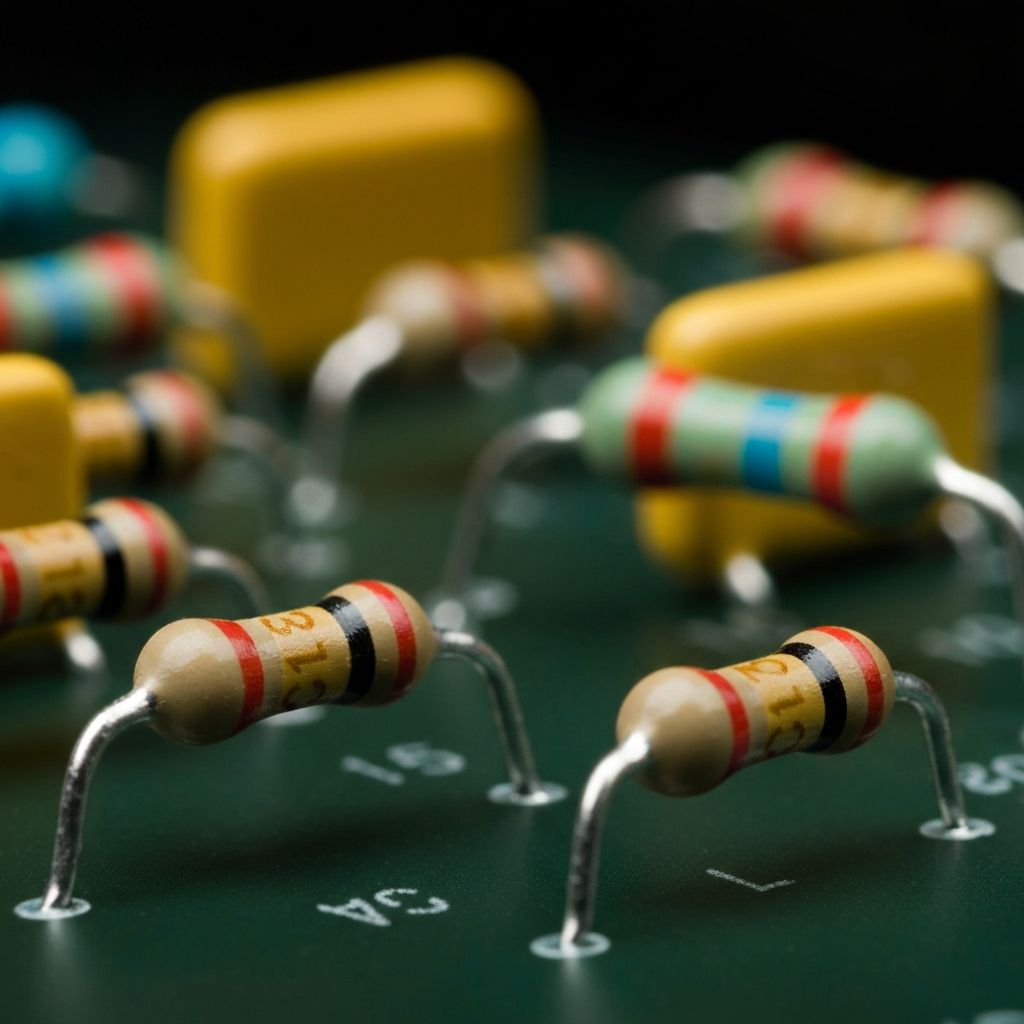
Resistance
Opposition to the flow of current
Ohm's Law states that the current through a conductor is directly proportional to the voltage across it, provided temperature remains constant:
V = I × R
Voltage (V) = Current (A) × Resistance (Ω)
This can be rearranged to find any unknown value: I = V/R or R = V/I. The "Ohm's Law triangle" helps remember these relationships.
The resistance of a wire depends on four factors:
R = ρL / A
R = Resistivity × Length ÷ Cross-sectional Area
- Material (ρ): Different materials have different resistivities. Copper has low resistivity; nichrome has high resistivity.
- Length (L): Longer wires have more resistance (directly proportional).
- Cross-sectional area (A): Thicker wires have less resistance (inversely proportional).
- Temperature: For metals, resistance increases as temperature rises.
An I-V characteristic graph shows how current varies with voltage for a component:
- Ohmic conductor (resistor): Straight line through origin. Resistance stays constant—follows Ohm's Law.
- Filament lamp: Curved line. As current increases, the filament heats up and resistance increases.
- Diode: Only conducts in one direction. Requires about 0.6V forward bias to start conducting.
Enter any TWO values to calculate the third
Ohm's Law
Question:
A copper wire has resistivity 1.7 × 10⁻⁸ Ω·m, length 2 m, and cross-sectional area 1 mm². Calculate its resistance.
Answer:
First convert area: 1 mm² = 1 × 10⁻⁶ m²
R = ρL / A
R = (1.7 × 10⁻⁸ × 2) / (1 × 10⁻⁶)
R = 3.4 × 10⁻⁸ / 1 × 10⁻⁶
R = 0.034 Ω
What is Ohm's Law?