Cell Division - Mitosis and Meiosis
How cells divide for growth and reproduction
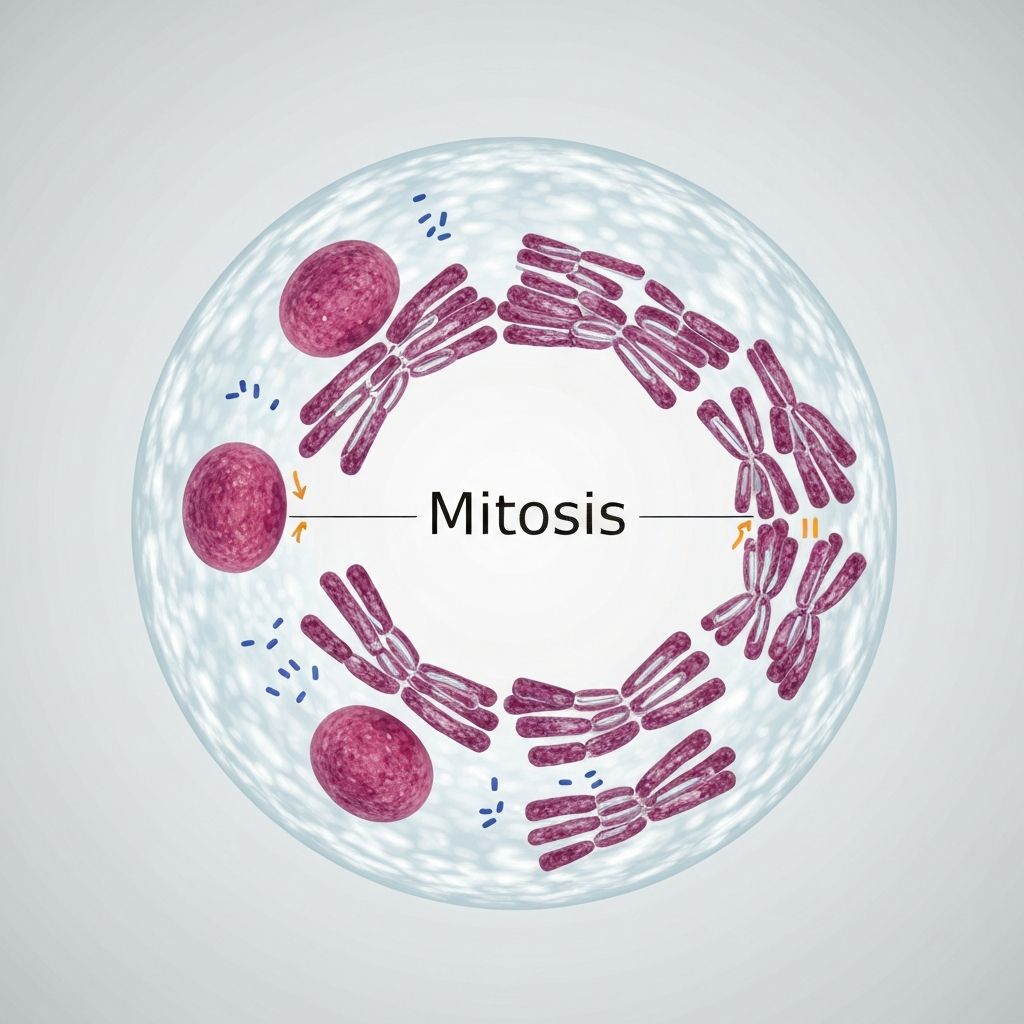
Two Types of Cell Division
Mitosis for growth, meiosis for reproduction
| Feature | Mitosis | Meiosis |
|---|---|---|
| Purpose | Growth, repair, asexual reproduction | Sexual reproduction (gamete formation) |
| Number of divisions | One division | Two divisions (I and II) |
| Daughter cells produced | 2 cells | 4 cells |
| Chromosome number | Diploid → Diploid (2n → 2n) | Diploid → Haploid (2n → n) |
| Genetic variation | Identical cells (clones) | Different cells (genetic variation) |
| Crossing over | No | Yes (during Meiosis I) |
Mitosis is cell division that produces two genetically identical daughter cells, each with the same number of chromosomes as the parent cell. It is used for growth, tissue repair, and asexual reproduction.
Stages of Mitosis (PMAT + C)
1. Prophase
Chromosomes condense and become visible. Nuclear membrane breaks down. Spindle fibers form.
2. Metaphase
Chromosomes line up along the cell equator (middle). Spindle fibers attach to centromeres.
3. Anaphase
Sister chromatids separate and move to opposite poles of the cell. Pulled by spindle fibers.
4. Telophase
Chromosomes decondense. Nuclear membranes reform around each set of chromosomes. Two nuclei form.
5. Cytokinesis
Cytoplasm divides, creating two separate daughter cells. Complete physical separation.
Interphase
Cell prepares for division. DNA replicates, creating two copies of each chromosome.
46 (diploid)
Key Events:
- •DNA replication occurs
- •Cell grows and prepares
- •Not technically part of mitosis
Meiosis is cell division that produces four genetically different daughter cells, each with half the number of chromosomes (haploid). It creates sex cells (gametes): sperm and egg cells.
Two Divisions in Meiosis
Meiosis I (Reduction Division)
- Homologous chromosome pairs separate
- Crossing over occurs - homologous chromosomes exchange genetic material
- Results in 2 cells with half the chromosome number (haploid)
Meiosis II (Similar to Mitosis)
- Sister chromatids separate (like in mitosis)
- No chromosome replication between divisions
- Results in 4 haploid cells, all genetically different
Crossing Over - Source of Variation
During Meiosis I, homologous chromosomes pair up and exchange segments of DNA. This creates new combinations of alleles, increasing genetic diversity in offspring. It is one reason why siblings (except identical twins) look different from each other.
Starting Cell
Diploid cell with replicated DNA ready to begin meiosis.
46 (diploid, 2n)
1 cell(s)
Key Events:
- •DNA has been replicated
- •Homologous pairs present
- •Ready for Meiosis I
Question: A human cell has 46 chromosomes (diploid number = 46). Track the chromosome number through meiosis I and meiosis II to form sperm cells.
Starting Point
Original cell: 46 chromosomes (diploid, 2n = 46)
Contains 23 pairs of homologous chromosomes
After Meiosis I
2 cells produced: Each has 23 chromosomes (haploid, n = 23)
Homologous pairs have separated. Each cell has one chromosome from each pair.
Crossing over has created new genetic combinations.
After Meiosis II
4 sperm cells produced: Each has 23 chromosomes (haploid, n = 23)
Sister chromatids have separated. Each gamete is genetically unique.
Summary
46 → 23 → 23
Diploid (2n = 46) → Meiosis I → Haploid (n = 23) → Meiosis II → Haploid (n = 23)
When a sperm (23) fertilizes an egg (23), the resulting zygote has 46 chromosomes again - restoring the diploid number.
1. How many cells are produced at the end of mitosis?
2. How many cells are produced at the end of meiosis?
3. In which stage do chromosomes line up at the cell equator?
4. What is the main purpose of mitosis?
5. When does crossing over occur?
6. If a diploid cell has 20 chromosomes, how many will each cell have after meiosis?
7. Which type of cell division creates genetic variation?
8. What happens during anaphase?