Generators and Transformers
Understand how generators produce electricity and how transformers change voltage
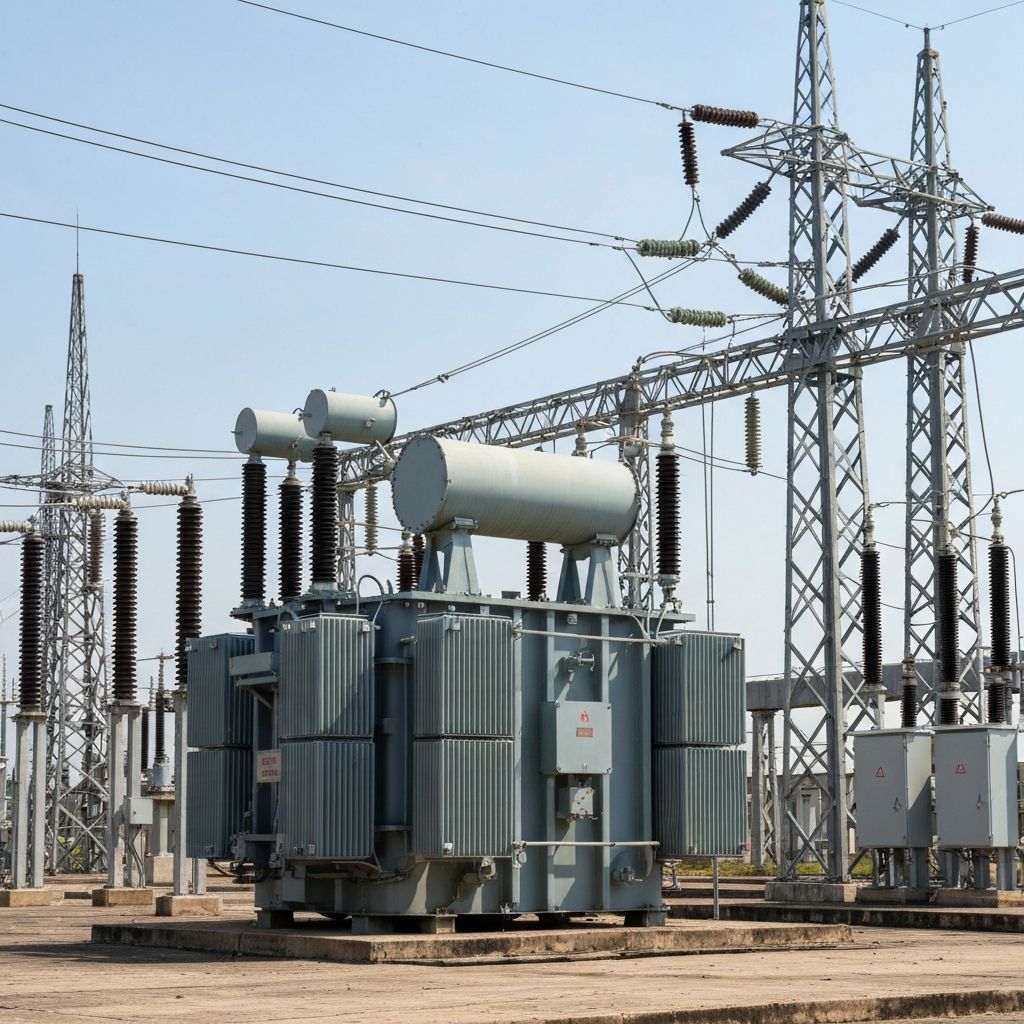
Power Generation
From generator to your home
An AC generator (alternator) produces electricity by rotating a coil in a magnetic field. This is the reverse of the motor effect—electromagnetic induction.
As the coil rotates, the magnetic flux through it changes continuously. This changing flux induces an EMF (voltage) in the coil. The output is alternating current (AC) because the direction of the induced EMF reverses every half rotation.
Slip rings (continuous rings) maintain electrical contact with the rotating coil, allowing the AC to flow to the external circuit. This differs from a motor's split-ring commutator.
A transformer changes the voltage of an AC supply using electromagnetic induction. It consists of two coils wound around a shared iron core.
Vp/Vs = Np/Ns
Primary voltage / Secondary voltage = Primary turns / Secondary turns
- Step-up transformer: Ns > Np → increases voltage (power stations to grid)
- Step-down transformer: Ns < Np → decreases voltage (substations, chargers)
Important: Transformers only work with AC because they need a changing magnetic field in the primary coil to induce current in the secondary.
Power stations generate electricity at ~25,000 V. This is stepped up to ~400,000 V for transmission across the country, then stepped down to 230 V for homes.
Why high voltage?
Power = Voltage × Current (P = VI), so for the same power, higher voltage means lower current. Energy loss in cables = I²R, so lower current means much less energy wasted as heat in the transmission lines.
Output Voltage
0.0 V
AC Output (sine wave)
How it works: Rotating the coil in the magnetic field changes the magnetic flux through it, inducing an EMF (voltage). The output is AC because the direction of flux change reverses each half rotation.
AC Generator
Question:
A transformer has 500 primary turns and 50 secondary turns. If the primary voltage is 230 V, calculate: (a) the secondary voltage, (b) the primary current if the secondary current is 10 A (assuming 100% efficiency).
Answer:
(a) Using Vp/Vs = Np/Ns:
230/Vs = 500/50
Vs = 230 × 50/500 = 23 V (step-down)
(b) Using power conservation (VpIp = VsIs):
230 × Ip = 23 × 10
Ip = 230/230 = 1 A
Note: The step-down in voltage results in a step-up in current.
What type of current does an AC generator produce?