Magnetism – Magnets and Magnetic Fields
Understand magnetic poles, field lines, and the behavior of magnetic materials
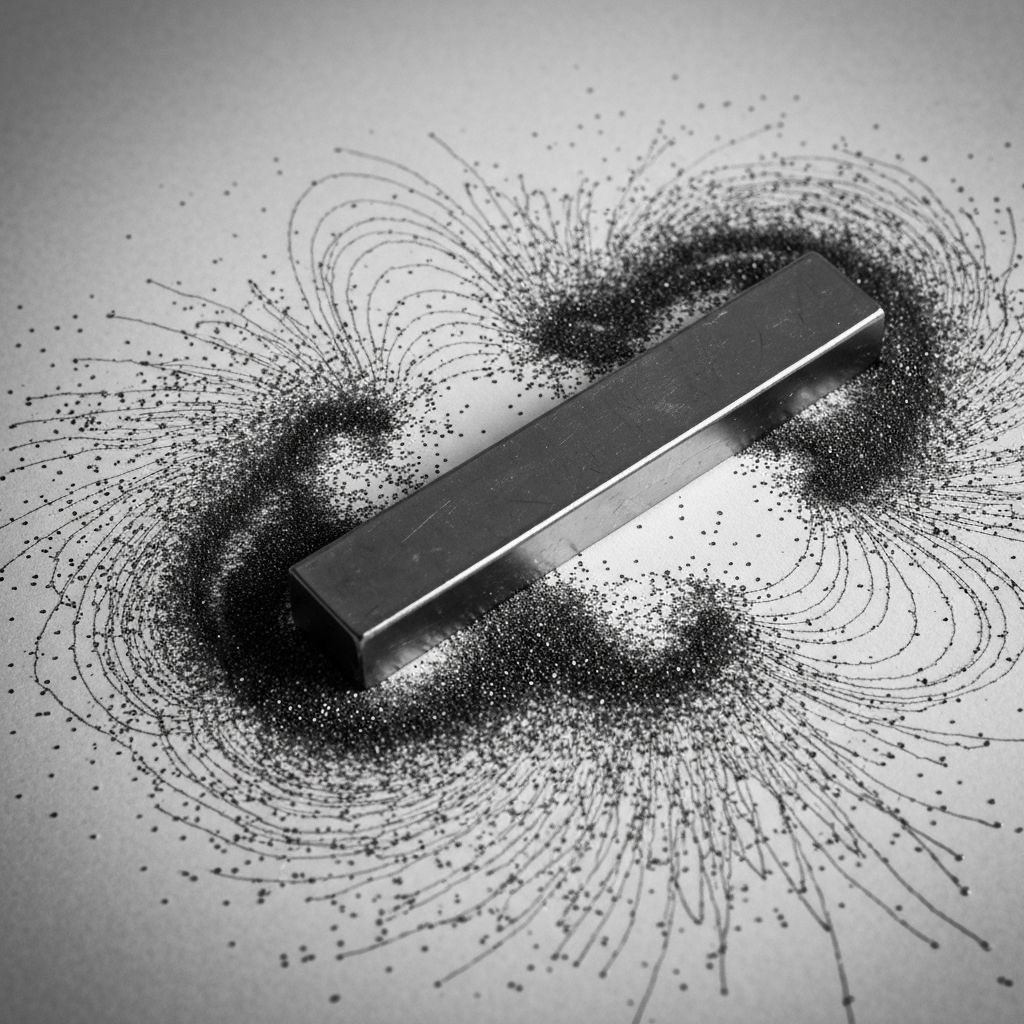
Magnetic Fields
Invisible forces made visible
Every magnet has two poles: North (N) and South (S). These are the regions where the magnetic force is strongest. The fundamental rule of magnetism is:
Opposite poles ATTRACT (N-S)
Like poles REPEL (N-N or S-S)
You cannot have a magnetic monopole—cutting a magnet in half creates two smaller magnets, each with its own N and S pole.
A magnetic field is the region around a magnet where magnetic forces act on other magnetic materials. We represent these fields using field lines:
- Field lines emerge from the North pole and enter the South pole
- Lines never cross each other
- Closer lines indicate a stronger field
- Lines form complete loops (continuing inside the magnet from S to N)
Magnetic field strength is measured in Tesla (T). Earth's magnetic field is about 50 µT, while a fridge magnet is about 5 mT.
Ferrous materials are attracted to magnets. These include iron, steel, nickel, and cobalt. These materials can become temporary magnets through induced magnetism when placed near a magnet.
Non-ferrous materials like copper, aluminum, brass, and gold are not attracted to magnets.
Permanent Magnets
Retain magnetism (bar magnets, horseshoe magnets)
Temporary Magnets
Induced magnetism only when near another magnet
North Pole (N)
Field lines emerge from N pole
South Pole (S)
Field lines enter the S pole
Earth behaves like a giant bar magnet with its magnetic south pole near the geographic North Pole. This field is generated by convection currents in Earth's liquid iron core.
A compass needle aligns with Earth's magnetic field, pointing towards magnetic north. Earth's magnetic field also protects us from harmful solar radiation by deflecting charged particles.
Magnetic Field
Question:
Two bar magnets are placed end-to-end with their North poles facing each other. Describe what happens and draw the field lines between them.
Answer:
The magnets will repel each other because like poles (N-N) repel.
The field lines between them will curve away from each other, not connecting. Each N pole's field lines will curve outward and around to their own S poles, creating a neutral point between the magnets where the field is zero.
What happens when two north poles are brought together?