Electromagnetic Induction, Generators, and Motors
Understanding how motion creates electricity and electricity creates motion
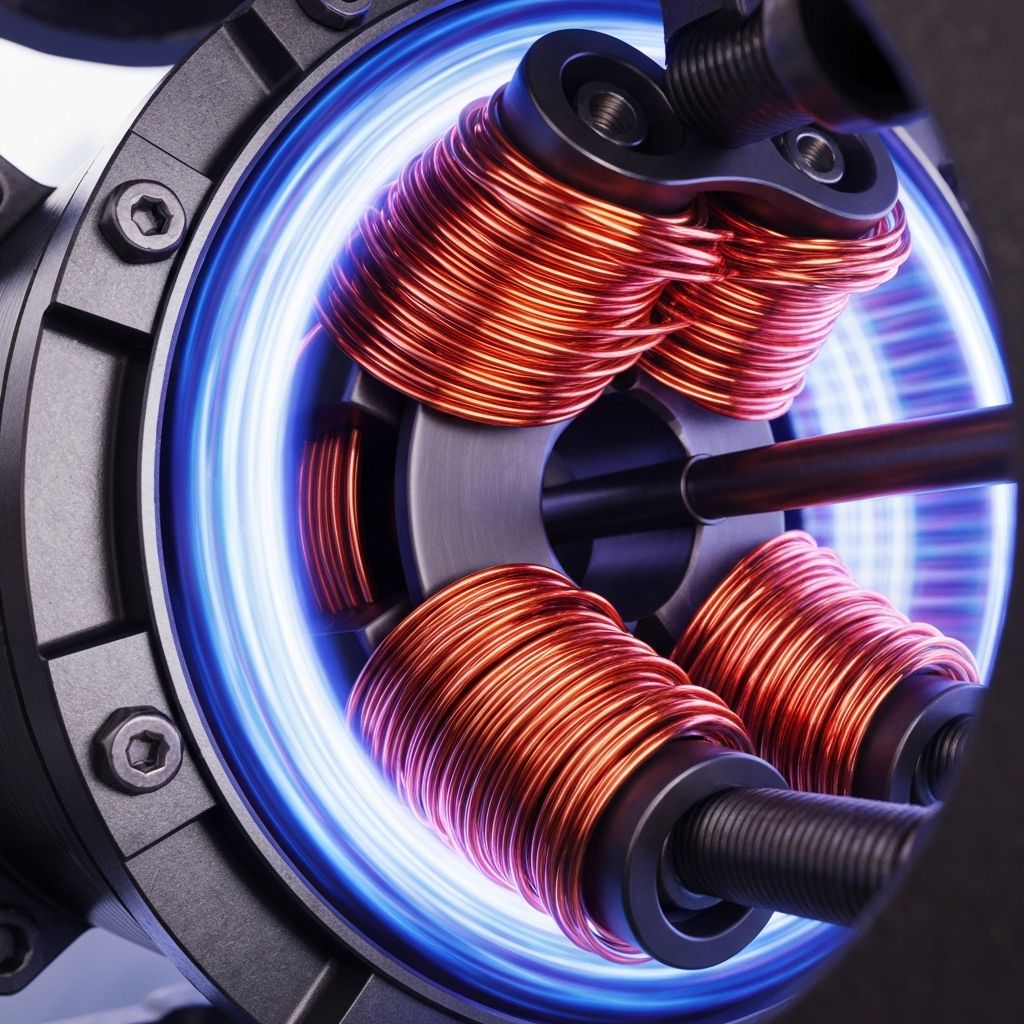
Electromagnetic Induction
The link between motion and electricity
When a conductor cuts through magnetic field lines, or when a magnetic field through a conductor changes, a voltage is induced. This is electromagnetic induction.
Moving magnet into coil
→ Induces voltage
Moving conductor through field
→ Induces voltage
Key requirement: Relative motion between magnet and conductor. No motion = no induced voltage.
Faster Movement
Greater rate of cutting field lines = larger voltage
Stronger Magnet
More field lines cut per second = larger voltage
More Coil Turns
Each turn contributes to total = larger voltage
The induced current always flows in a direction that opposes the change causing it:
- Moving magnet's north pole toward coil → induced current creates north pole facing magnet (repels)
- Moving magnet away from coil → induced current creates south pole facing magnet (attracts)
This is a consequence of conservation of energy - you must do work to induce current.
An AC generator produces electricity by rotating a coil in a magnetic field:
- Construction: Coil rotates between two magnetic poles
- Slip rings: Two complete rings maintain continuous electrical contact
- Brushes: Carbon contacts that touch slip rings
- Operation: As coil rotates, it cuts field lines → voltage induced
- Output: Alternating current (sine wave) - direction reverses every half turn
Uses: Power stations (coal, gas, nuclear, wind) generate electricity this way.
A DC motor uses the motor effect (F = BIL) to produce continuous rotation:
- Construction: Current-carrying coil in magnetic field
- Split-ring commutator: Ring split into two halves
- Operation: Current experiences force, commutator reverses current every half turn
- Result: Rotation continues in same direction
Uses: Electric drills, fans, electric cars.
Key Factors Affecting Induced Voltage
- • Faster movement = greater rate of cutting field lines = larger voltage
- • Stronger magnet = more field lines cut per second = larger voltage
- • More coil turns = each turn contributes to total = larger voltage
- • No movement = no induced voltage (relative motion required)
Motor Effect
Example 1: Increasing Generator Output
Question: Explain how increasing rotation speed in a generator increases output voltage.
Answer: When the coil rotates faster, it cuts through the magnetic field lines at a greater rate. Since induced voltage depends on the rate of change of magnetic flux, faster rotation means more field lines are cut per second, resulting in a higher induced voltage. The frequency of the AC output also increases.
Example 2: Generator vs Motor Components
Question: Describe the difference between slip rings and a split-ring commutator.
Answer: Slip rings are two complete, unbroken rings used in AC generators. They maintain continuous contact and allow the alternating current to flow unchanged. A split-ring commutator is a single ring split into two halves, used in DC motors. It reverses the direction of current every half turn, ensuring the motor continues rotating in the same direction rather than oscillating back and forth.
What is the formula for the motor effect force?