Galaxies, the Universe, and the Big Bang
Explore the large-scale structure of the universe and its origins
The Expanding Universe
From the Big Bang to galaxies today
Galaxies are enormous systems containing billions of stars, held together by gravity. There are three main types:
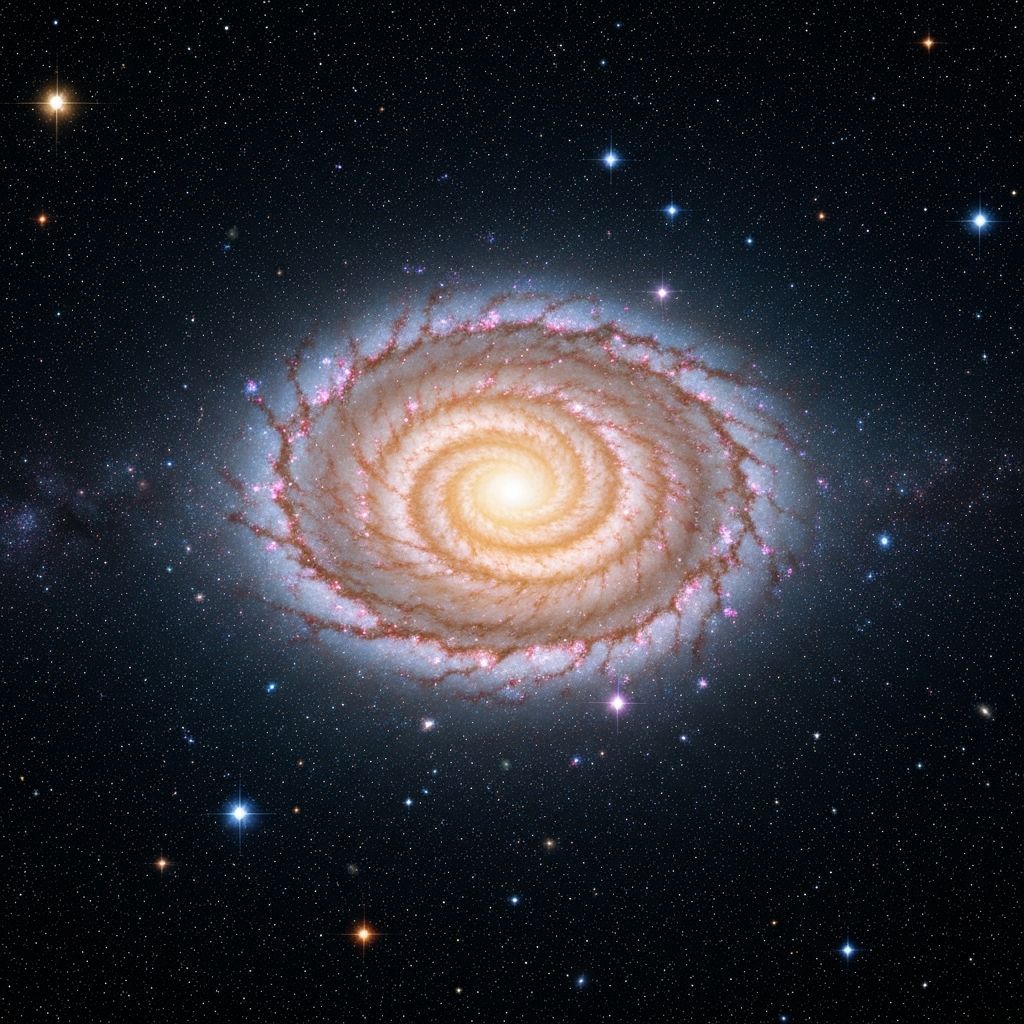
- Spiral: Flat disk with rotating arms, active star formation (e.g., Milky Way)
- Elliptical: Ball-shaped, older stars, little new star formation
- Irregular: No definite shape, often from galaxy collisions
Our Milky Way is a spiral galaxy containing 100-400 billion stars. The Sun orbits the galactic center every ~250 million years.
Redshift is the stretching of light to longer wavelengths. Light from distant galaxies is redshifted because they're moving away from us—the Doppler effect for light.
Hubble's Law: v = H₀d
Recession velocity = Hubble constant × distance
Hubble's discovery: The greater a galaxy's redshift, the faster it's moving away and the farther it is. This proves the universe is expanding—space itself is stretching.
If the universe is expanding, running time backwards suggests it started from a single point. The Big Bang theory states the universe began approximately 13.8 billion years ago as an extremely hot, dense state.
As space expanded and cooled, particles formed, then atoms, then stars and galaxies. Key evidence includes:
- Universal expansion: All galaxies moving apart (redshift)
- Cosmic Microwave Background: Radiation "afterglow" from early universe
- Element abundance: Observed hydrogen/helium ratios match Big Bang predictions
Spiral Galaxy
Flat disk with rotating arms, active star formation. Example: Milky Way
Galaxy
Question:
A galaxy has a recession velocity of 14,000 km/s. Using H₀ = 70 km/s/Mpc, calculate its distance.
Answer:
Using Hubble's Law: v = H₀d
Rearranging: d = v / H₀
d = 14,000 / 70
d = 200 Mpc (megaparsecs)
Converting: 200 Mpc ≈ 650 million light-years away
What type of galaxy is the Milky Way?