Reflection and Refraction
How waves behave at boundaries between different media
Reflection and Refraction
Bending and bouncing of waves
Reflection occurs when a wave bounces off a surface. The key principle is the law of reflection:
Angle of incidence = Angle of reflection
Both angles are measured from the normal—an imaginary line perpendicular to the surface at the point where the wave hits. This law applies to all waves: light, sound, and water waves.
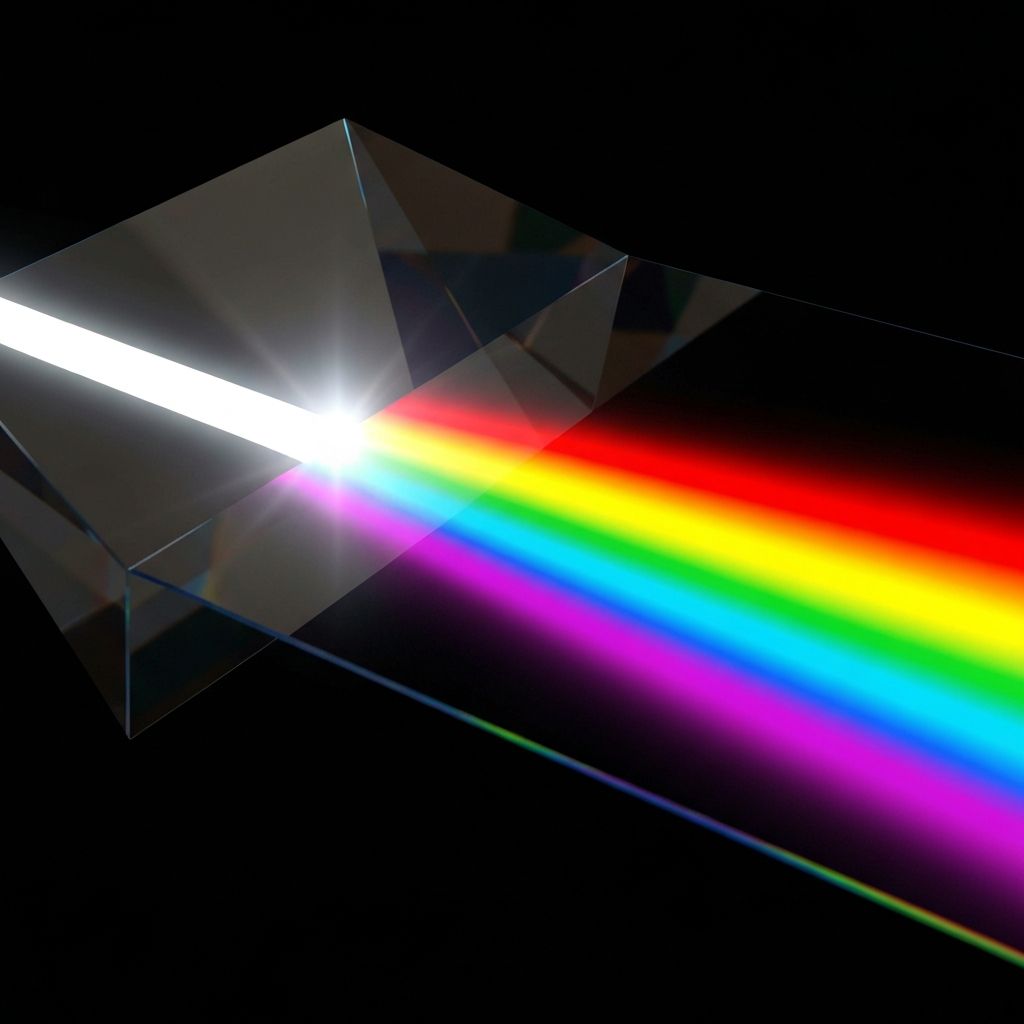
Refraction is the bending of waves when they pass from one medium to another. This happens because waves travel at different speeds in different materials.
Light slows down in denser media (like glass or water) and bends toward the normal. When light exits to a less dense medium, it speeds up and bends away from the normal.
Interestingly, sound behaves oppositely—it travels faster in denser media.
The refractive index (n) measures how much a material slows down light:
n = c ÷ v
(speed of light in vacuum ÷ speed in material)
Snell's Law relates the angles and refractive indices:
n₁ sin θ₁ = n₂ sin θ₂
Common values: air ≈ 1.0, water ≈ 1.33, glass ≈ 1.5, diamond ≈ 2.4
When light travels from a denser to a less dense medium (e.g., glass to air), there's a special angle called the critical angle. At angles greater than this, the light cannot escape—it all reflects back inside. This is total internal reflection (TIR).
TIR is used in optical fibers to transmit data as light pulses over long distances without signal loss. It's also why diamonds sparkle so brilliantly—their high refractive index creates a small critical angle, trapping light inside.
Measurements
Angle of Incidence (θᵢ)
45°
Angle of Reflection (θᵣ)
45°
Reflection
Question:
Light travels from air (n = 1.0) into glass (n = 1.5) at an angle of incidence of 45°. Calculate the angle of refraction.
Answer:
Using Snell's Law: n₁ sin θ₁ = n₂ sin θ₂
1.0 × sin(45°) = 1.5 × sin θ₂
sin θ₂ = (1.0 × 0.707) ÷ 1.5 = 0.471
θ₂ = sin⁻¹(0.471) = 28.1°
The light bends toward the normal as it enters the denser medium.
What is the law of reflection?