Balanced and Unbalanced Forces
Understand how balanced and unbalanced forces affect motion
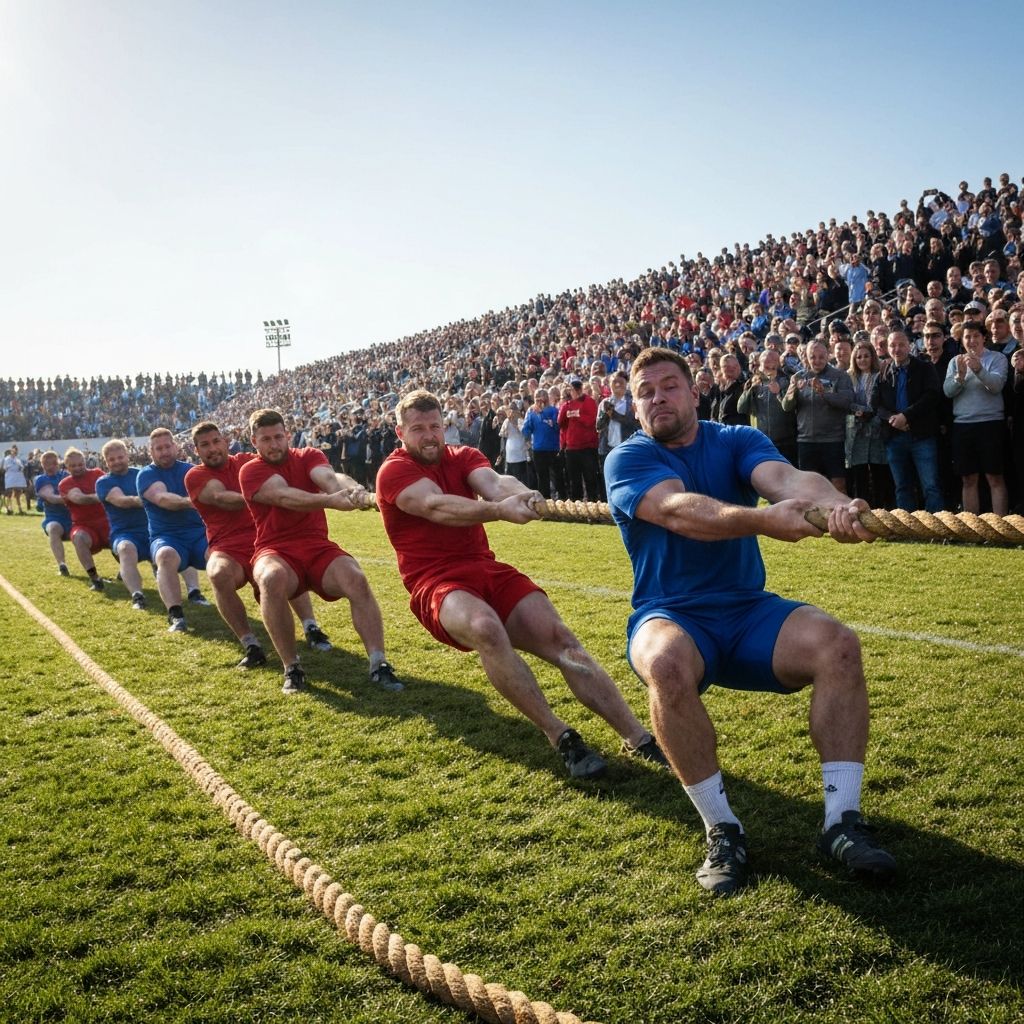
Force Balance
When forces cancel out
Balanced forces occur when forces acting on an object are equal in magnitude but opposite in direction. The resultant (net) force is zero, meaning no acceleration occurs.
Examples of balanced forces:
- Object on a table: Weight down = Normal reaction up
- Car at constant speed: Driving force = Friction + Air resistance
- Parachutist at terminal velocity: Weight = Air resistance
Key Point: Balanced forces don't mean "no motion"—they mean "no change in motion". An object can move at constant velocity with balanced forces (Newton's First Law).
Unbalanced forces occur when forces don't cancel out—there is a net (resultant) force. This causes the object to accelerate in the direction of the net force.
The acceleration depends on the net force and mass according to Newton's Second Law: a = F/m
- Horizontal unbalanced force: Object accelerates horizontally
- Vertical unbalanced force: Object accelerates vertically (e.g., falling objects)
Friction is a force that opposes motion between surfaces in contact. It depends on the roughness of surfaces and the normal force pressing them together.
Air resistance (drag) is friction from moving through air. Key properties:
- Increases with speed (proportional to v² at high speeds)
- Increases with surface area facing the direction of motion
- Always opposes motion
Adjust Forces
Net Forces
Horizontal: 0 N (balanced)
Vertical: 0 N (balanced)
Balanced Forces
Question:
A 60 kg skydiver experiences a weight of 600 N and air resistance of 400 N. (a) What is the net force? (b) What is the acceleration? (c) What happens to motion?
Answer:
(a) Net Force:
Weight (down) = 600 N
Air resistance (up) = 400 N
Net force = 600 - 400 = 200 N downward
(b) Acceleration:
a = F/m = 200/60 = 3.3 m/s² downward
(c) Motion:
The skydiver accelerates downward (speeds up) because forces are unbalanced.
A book rests on a table. What forces are balanced?