Distance and Speed
Learn how to measure and calculate speed using distance-time relationships
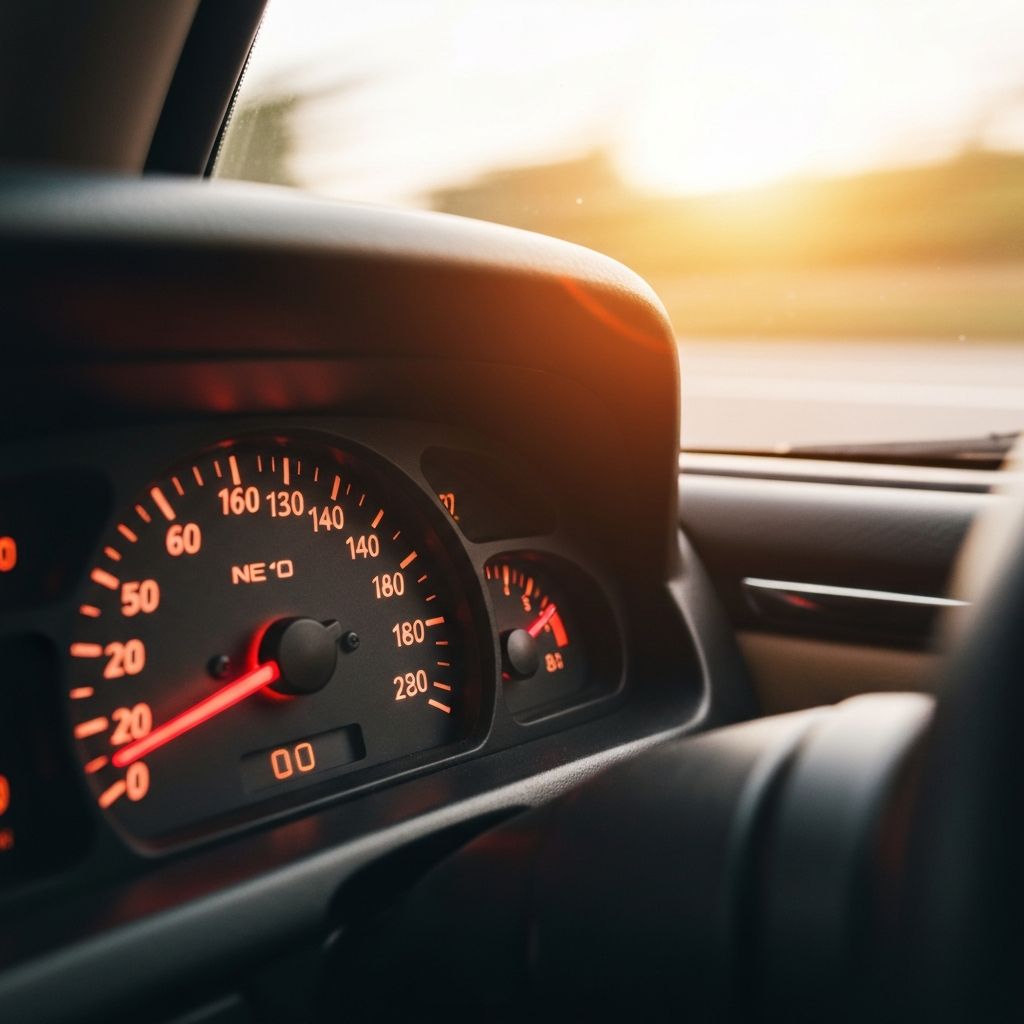
Speed and Motion
Measuring how fast objects move
Distance is the total path length traveled by an object. It's a scalar quantity, meaning it only has magnitude (size) and is always positive. If you walk 3 metres forward and 3 metres back, your total distance is 6 metres.
Displacement is the straight-line distance from your starting point to your finishing point, including direction. It's a vector quantity. In the example above, your displacement would be zero because you ended where you started.
Speed tells us how quickly an object covers distance. It's calculated using the formula:
speed = distance ÷ time
v = d / t
The SI unit for speed is metres per second (m/s). Other common units include km/h and mph. Speed is a scalar quantity—it has no direction.
Velocity is speed in a given direction. It's a vector quantity. An object moving at 10 m/s north has a different velocity to one moving at 10 m/s south, even though they have the same speed.
Example Calculation
A runner completes 100 m in 10 seconds.
Speed = 100 m ÷ 10 s = 10 m/s
Distance-time graphs show how the position of an object changes over time. The gradient (slope) of the line equals the speed.
- Horizontal line: Object is stationary (not moving) — gradient is zero
- Straight diagonal line: Constant speed — steeper = faster
- Curved line: Changing speed — acceleration or deceleration
To find average speed from a graph, divide the total distance traveled by the total time taken.
Adjust Distance at Each Time
Calculations
Total Distance: 80 m
Total Time: 8 s
Average Speed: 10.0 m/s
Speed = Distance ÷ Time
Graph Interpretation
- • Horizontal line = stationary (not moving)
- • Diagonal line = constant speed
- • Steeper gradient = faster speed
- • Curved line = changing speed
In experiments, speed can be measured using various methods:
- Stopwatch and ruler: Measure distance and time manually, then calculate
- Light gates: Electronic sensors that measure time precisely as an object passes through
- Ticker tape: A strip of paper pulled through a timer that dots every 0.02 seconds, showing distance intervals
Distance
Question:
A cyclist travels 200 m in the first 20 seconds, stops for 10 seconds, then travels another 150 m in 15 seconds. Calculate the average speed for the whole journey.
Answer:
Total distance = 200 m + 150 m = 350 m
Total time = 20 s + 10 s + 15 s = 45 s
Average speed = total distance ÷ total time
= 350 m ÷ 45 s = 7.78 m/s
A car travels 150 km in 3 hours. What is its average speed?