The Haber Process and Industrial Chemistry
Understanding industrial ammonia production and equilibrium optimization
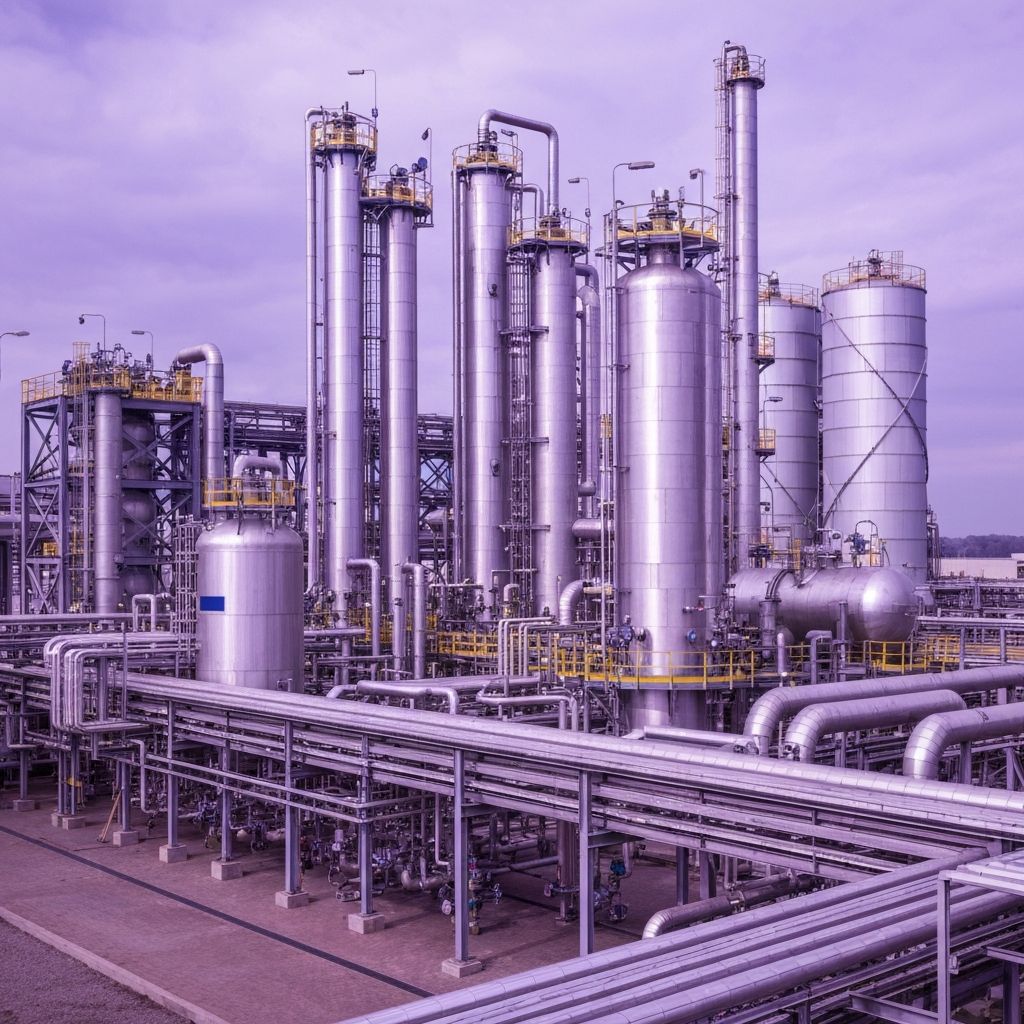
Making ammonia from thin air - the reaction that feeds the world
The Haber process is one of the most important industrial chemical reactions, producing ammonia (NH₃) from nitrogen and hydrogen gases. Developed by Fritz Haber in 1909, this process now produces over 150 million tonnes of ammonia annually, primarily for fertilizers that support roughly half of the world's food production.
The Reaction
The Haber process is a reversible reaction shown by the equation:
N₂(g) + 3H₂(g) ⇌ 2NH₃(g) ΔH = -92 kJ/mol
The forward reaction is exothermic (releases heat) and involves a decrease in the number of gas molecules (4 moles → 2 moles). These facts are crucial for understanding how to optimize the conditions.
Le Chatelier's Principle
Le Chatelier's principle states that when a system at equilibrium is disturbed, it shifts to counteract the change. For the Haber process:
- Increasing pressure shifts equilibrium toward fewer moles (forward, more NH₃)
- Decreasing temperature shifts equilibrium toward the exothermic direction (forward, more NH₃)
- Removing ammonia shifts equilibrium forward to replace it
The Industrial Compromise
Real industrial conditions balance yield against rate and economic factors:
- Temperature: ~450°C - A compromise between yield (lower is better) and rate (higher is faster)
- Pressure: ~200 atm - High enough for good yield but not dangerously or expensively high
- Iron catalyst - Speeds up the reaction without affecting yield
- Recycling - Unreacted gases are cooled, separated, and recycled
Typical: 400-500°C
Typical: 150-300 atm
Speeds up reaction only
N₂(g) + 3H₂(g) ⇌ 2NH₃(g)
ΔH = -92 kJ/mol (exothermic)
Ammonia Yield
18.0%
Reaction Rate
5.0x
Compromise
Optimal!
Example 1: Le Chatelier Prediction
Question: The temperature in a Haber process reactor is increased. What happens to the yield of ammonia and why?
Answer: The yield of ammonia decreases.
The forward reaction is exothermic (releases heat). When temperature increases, the system shifts to absorb the extra heat by favoring the endothermic (backward) direction. This means less ammonia is produced at equilibrium.
Example 2: Mole Calculation
Question: If 280 tonnes of nitrogen react completely with excess hydrogen, what mass of ammonia is produced? (Ar: N=14, H=1)
Step 1: Calculate moles of N₂
Mr of N₂ = 28, so moles = 280/28 = 10 million moles
Step 2: Use mole ratio
1 N₂ : 2 NH₃, so moles NH₃ = 20 million moles
Step 3: Calculate mass
Mr of NH₃ = 17, so mass = 20 × 17 = 340 tonnes
Flashcards
1 / 14Term
Haber Process
Click to reveal definition
What is the balanced equation for the Haber process?