Rates of Reaction
Understand the factors that affect how quickly reactions happen
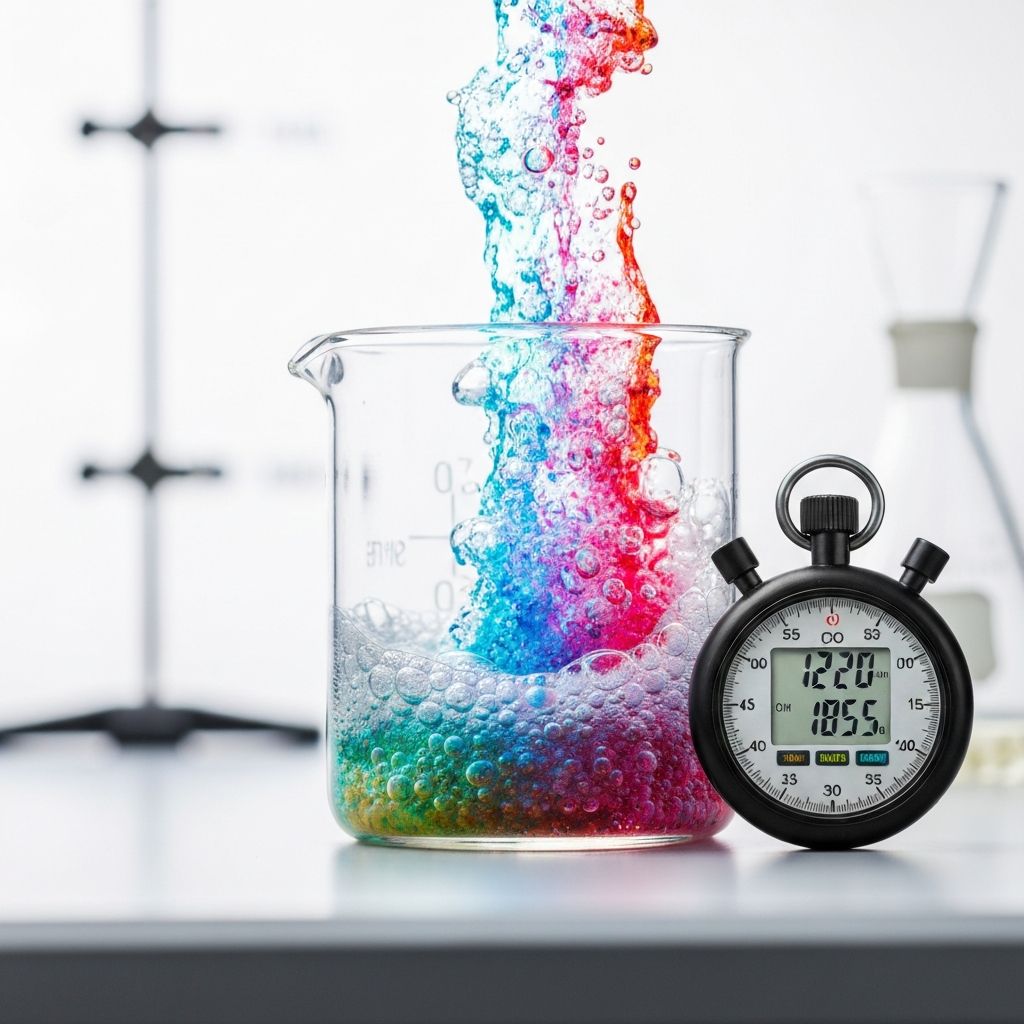
Reaction Speed
Five Key Factors
Rate of reaction measures how quickly reactants are converted into products. It can be calculated by measuring the amount of reactant used up or product formed over a period of time. Fast reactions (like explosions) happen in fractions of a second, while slow reactions (like rusting) take days or years.
Rate can be measured by: collecting gas volume produced over time, measuring mass lost as gas escapes, observing colour change intensity, or timing how long until a precipitate obscures a mark.
Collision theory explains that for a reaction to occur, reactant particles must collide with each other. But not every collision causes a reaction—particles must collide with sufficient energy (at least the activation energy) and with the correct orientation.
Anything that increases the frequency of collisions or the energy of collisions will increase the rate of reaction. This is the basis for understanding why the five factors affect rate.
Temperature: Higher temperature gives particles more kinetic energy. They move faster, collide more frequently, and more collisions have energy ≥ activation energy. A 10°C rise roughly doubles the rate.
Concentration: Higher concentration means more particles in the same volume. This increases collision frequency, so rate increases. For gases, increasing pressure has the same effect—particles are pushed closer together.
Surface area: Breaking a solid into smaller pieces exposes more particles at the surface. More particles can collide at the same time, increasing rate. Powder reacts faster than lumps.
Catalyst: A catalyst provides an alternative pathway with lower activation energy. More particles now have sufficient energy to react. Catalysts are not used up and can be reused.
Key Exam Point
Always explain rate changes in terms of collision frequency and collision energy. For example: "Increasing temperature increases rate because particles move faster, collide more frequently, and more collisions have energy greater than or equal to the activation energy."
Higher temperature = faster particle movement
Higher concentration = more particles to collide
Larger surface area = more exposed particles
Particle collision simulation
0% complete
Relative Rate: 1.00x
Slow reaction
Question:
Marble chips (CaCO₃) react with hydrochloric acid. Explain why using the same mass of powdered marble instead of chips would increase the rate of reaction.
Answer:
Powdered marble has a larger surface area than marble chips of the same mass.
With a larger surface area, more CaCO₃ particles are exposed at the surface and can come into contact with the acid particles.
This means there are more frequent collisions between acid and marble particles per second, so the rate of reaction increases.
According to collision theory, for a reaction to occur particles must: