Classification and Taxonomy
How scientists organize and name the millions of species on Earth
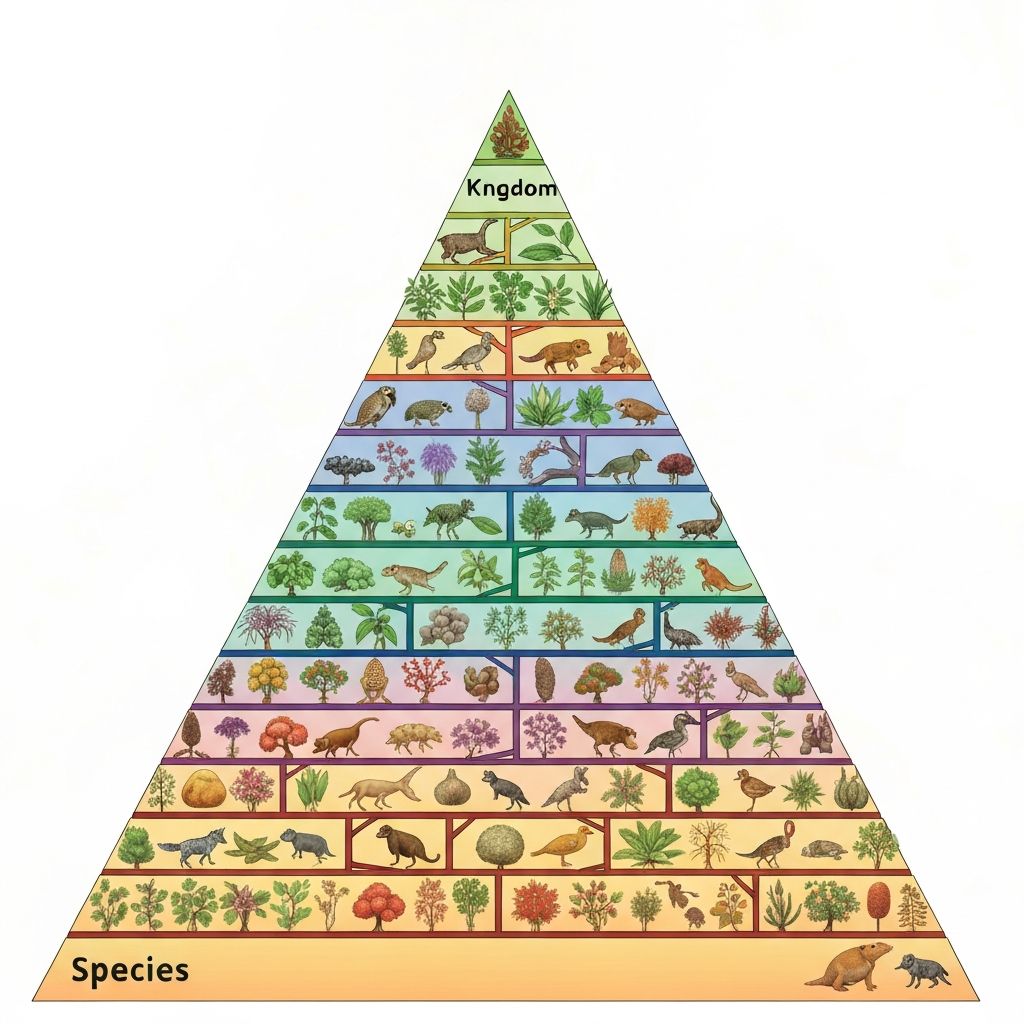
The Tree of Life
Kingdom → Phylum → Class → Order → Family → Genus → Species
Scientists have discovered millions of different species. To make sense of this diversity, we use a classification system that groups organisms based on their similarities. This helps us identify species, understand how they evolved, and study relationships between different organisms.
The Five Kingdoms
All living things are divided into five major kingdoms: Animals (multicellular organisms that eat other organisms), Plants (multicellular organisms that make their own food through photosynthesis), Fungi (organisms like mushrooms that absorb nutrients from dead material), Protoctists (mostly single-celled organisms like amoebas), and Prokaryotes (bacteria with no nucleus).
The Taxonomic Hierarchy
Within each kingdom, organisms are further classified into smaller groups. The order is: Kingdom → Phylum → Class → Order → Family → Genus → Species. Each level gets more specific. For example, humans belong to the Animal kingdom, Chordata phylum, Mammalia class, Primates order, Hominidae family, Homo genus, and sapiens species.
Binomial Nomenclature
Every species has a unique two-part scientific name called binomial nomenclature. The first part is the Genus (always capitalized) and the second part is the species (lowercase). For example, humans are Homo sapiens, dogs are Canis familiaris, and oak trees are Quercus robur. These Latin names are used worldwide so scientists can communicate clearly regardless of language.
Why Latin Names?
Latin is a "dead" language that no longer changes. This ensures scientific names stay consistent across all countries and throughout history. A dog might be called "perro" in Spanish, "chien" in French, but Canis familiaris is understood everywhere.
Scientific Name: Homo sapiens
Term
Classification
Click to reveal definition
Question:
Classify a domestic cat (Felis catus) through the complete taxonomic hierarchy.
Answer:
Scientific name: Felis catus (Genus + species)
Lion
Rose
Mushroom
Amoeba
E. coli
Fern